
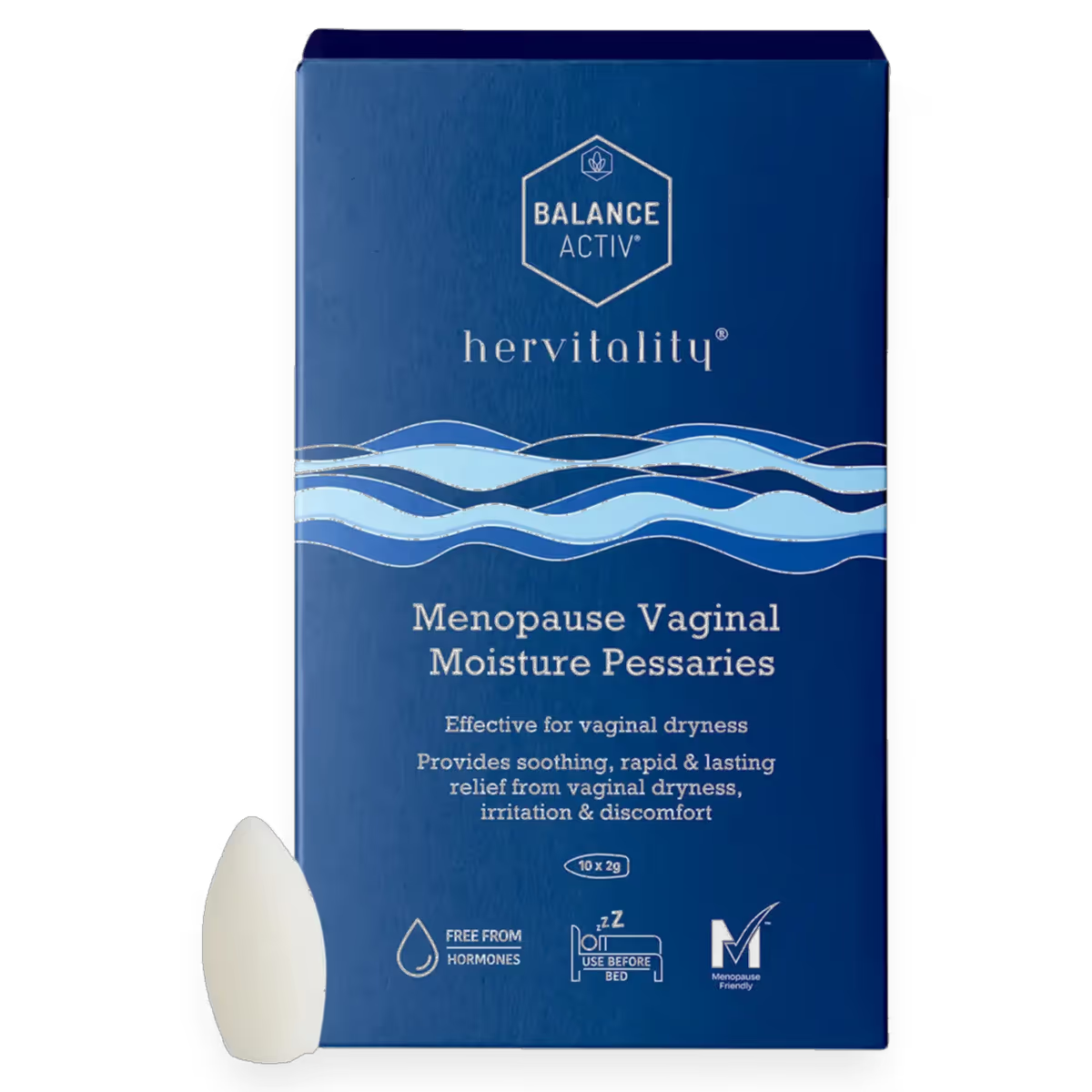
Balance Activ Hervitality Vaginal Dryness Pessaries
Can they prove what they say?
Kind of, with a few overclaims. Balance Activ's lead ingredient is hyaluronic acid, which has a growing body of trial evidence supporting its use for vaginal dryness. But it won't treat the underlying cause of the dryness--only local oestrogen can do that, so claiming to "restore natural moisture levels" doesn't stack up.
What it is:
Balance Activ Hervitality pessaries are over-the-counter pessaries inserted at bedtime. They melt at body temperature to release their active ingredients: hyaluronic acid, vitamin E, vitamin A, and aloe vera extract. The waxy base means they are not compatible with condoms.
What do the guidelines say?
NICE [1], BMS/BSSM [2], NAMS [3], and EMAS [4] all recognise non-hormonal vaginal moisturisers as an appropriate treatment option. NICE recommends vaginal oestrogen as first-line but specifically recommends non-hormonal moisturisers for women with a history of breast cancer [1]. NAMS lists them as first-line for mild to moderate symptoms [3]. EMAS includes hyaluronic acid-based products by name as an option [4]. No guideline names this specific product. They refer to the category, not the brand.
What does the evidence say?
This specific product: One open-label study with no control group tested suppositories with the same hyaluronic acid/vitamin E/vitamin A combination in 150 postmenopausal women and reported symptom improvements [5]. Without a placebo group, this cannot tell us how much was due to the product itself. It is not an RCT.
Hyaluronic acid: The strongest evidence of any ingredient here. Multiple systematic reviews [6][7] and a 2025 meta-analysis of placebo-controlled RCTs [9] found it significantly improves vaginal dryness, quality of life, and sexual function, with a safety profile comparable to vaginal oestrogen. A 2024 pilot RCT found no difference between hyaluronic acid suppositories and vaginal oestrogen cream over 12 weeks [8]. Evidence rated moderate quality. Most studies are short-term and small.
Vitamin E: A 2022 systematic review found only four eligible RCTs [10]. One small trial (42 women) showed benefit over placebo; another (52 women) showed improvement but oestrogen cream worked faster [11]. Too early to draw firm conclusions. No major society recommends it yet [10].
Aloe vera: One small RCT (60 women) found it comparable to oestrogen cream over 6 weeks [12]. A single small study is not enough to be confident.
Vitamin A: No RCTs found testing it independently for menopausal vaginal dryness. Its contribution is unknown.
Semisynthetic glycerides: The suppository base (carrier), not an active ingredient.
References
[1] NICE. Menopause: identification and management (NG23). Updated November 2024. Available at: https://www.nice.org.uk/guidance/ng23. No PMID (clinical guideline).
[2] BSSM. Position statement for management of genitourinary syndrome of the menopause (GSM). 2024. Available at: https://bssm.org.uk/wp-content/uploads/2024/03/BSSM-Position-statement-for-management-of-genitourinary-syndrome-of-the-menopause-GSM.pdf. No PMID (clinical guideline).
[3] Faubion S et al. The 2020 genitourinary syndrome of menopause position statement of The North American Menopause Society. Menopause 2020;27:976-992. PMID: 32852449. https://pubmed.ncbi.nlm.nih.gov/32852449/
[4] EMAS. Topical estrogens and non-hormonal preparations for postmenopausal vulvovaginal atrophy: An EMAS clinical guide. Maturitas 2021;148:34-38. Available at: https://www.maturitas.org/article/S0378-5122(21)00061-X/fulltext. No PMID listed in search (clinical guideline).
[5] Costantino D, Guaraldi C. Effectiveness and safety of vaginal suppositories for the treatment of the vaginal atrophy in postmenopausal women: an open, non-controlled clinical trial. Eur Rev Med Pharmacol Sci 2008;12:411-416. PMID: 19146203. https://pubmed.ncbi.nlm.nih.gov/19146203/
[6] dos Santos CCM et al. Hyaluronic acid in postmenopause vaginal atrophy: a systematic review. J Sex Med 2021;18:156-166. PMID: 33293236. https://pubmed.ncbi.nlm.nih.gov/33293236/
[7] Sayed GH et al. Comparison of the efficacy of vaginal hyaluronic acid to estrogen for the treatment of vaginal atrophy in postmenopausal women: a systematic review. Cureus 2023;15:e44191. Available at: https://pmc.ncbi.nlm.nih.gov/articles/PMC10520994/
[8] Agrawal S et al. A randomized, pilot trial comparing vaginal hyaluronic acid to vaginal estrogen for the treatment of genitourinary syndrome of menopause. Menopause 2024;31:750-755. PMID: 39042017. https://pubmed.ncbi.nlm.nih.gov/39042017/
[9] Dahab S et al. Hyaluronic acid for vaginal health and quality of life in postmenopausal women: a systematic review and meta-analysis of randomized controlled trials. Int J Gynecol Obstet 2025 (published online). Available at: https://obgyn.onlinelibrary.wiley.com/doi/10.1002/ijgo.70887
[10] Bauer E et al. Vaginal vitamin E for treatment of genitourinary syndrome of menopause: a systematic review of randomized controlled trials. J Menopausal Med 2022;28:9-16. Available at: https://pmc.ncbi.nlm.nih.gov/articles/PMC9086347/
[11] Parnan Emamverdikhan A et al. A survey of the therapeutic effects of vitamin E suppositories on vaginal atrophy in postmenopausal women. Iran J Nurs Midwifery Res 2016;21:475-481. PMID: 27904630. https://pubmed.ncbi.nlm.nih.gov/27904630/
[12] Poordast T et al. Aloe vera; a new treatment for atrophic vaginitis, a randomized double-blinded controlled trial. J Ethnopharmacol 2021;270:113760. PMID: 33383112. https://pubmed.ncbi.nlm.nih.gov/33383112/
Vitamin E
Vitamin A
Aloe vera
Glycerin
Hyaluronic acid
Water

Related Articles
You might be intrested in reading...