
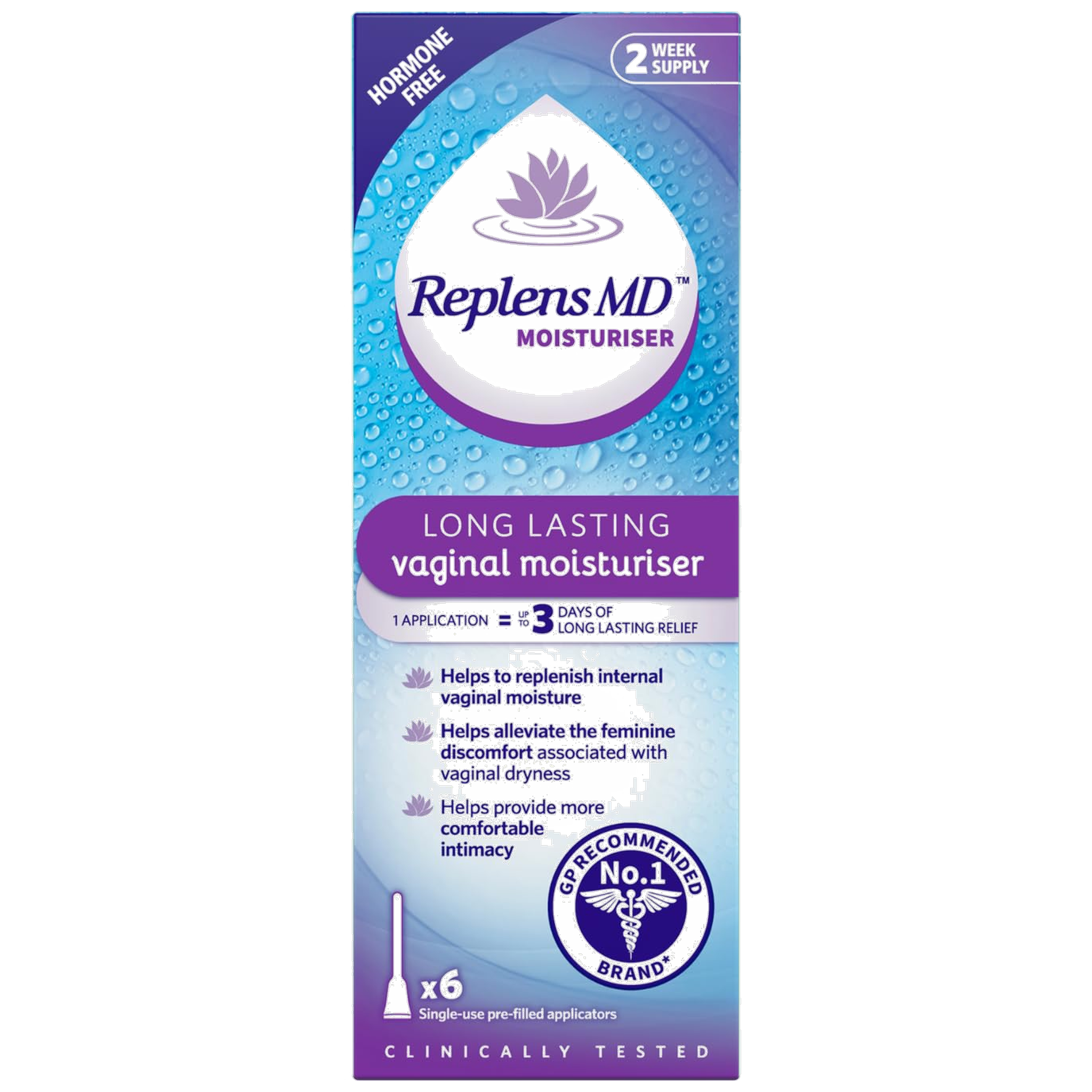
Replens MD Vaginal Moisturiser
Can they prove what they say?
Yes, as long as you're ok with short-term results. Replens probably has more quality evidence supporting its use for vaginal dryness than any other moisturiser, even comparing favourably to localised oestrogen. But it won't treat the underlying cause of the dryness--only local oestrogen can do that.
What it is:
Replens MD is a non-hormonal vaginal moisturiser for dryness linked to perimenopause and menopause.
What do the guidelines say?
- The updated NICE guideline (NG23, 2024) recommends vaginal oestrogen as the first-line treatment for genitourinary symptoms of menopause [1]. Non-hormonal moisturisers and lubricants are recommended for women with a history of breast cancer, or for those who prefer not to use or cannot use vaginal oestrogen [1]. The guideline also notes that moisturisers can be used alongside vaginal oestrogen [1]. No specific brands are named.
- The BMS/BSSM joint position statement (2024) recommends vaginal moisturisers and lubricants for women with GSM, either alone or alongside vaginal or systemic hormone therapy [2]. Again, no specific products are named. The statement positions moisturisers as particularly useful for women whose dryness is mainly a concern during sex, or who have contraindications to hormones [2].
- The Menopause Society (formerly NAMS, 2020/2025) recommends non-hormonal moisturisers and lubricants as first-line for milder symptoms, with prescription treatments for more bothersome cases [5][6]. Replens is named as an example of a vaginal moisturiser in the Society's patient information, but this is not an endorsement of it over other products [5].
- Across all guidelines, the position is consistent: moisturisers are a reasonable option, especially when hormones are not suitable, but vaginal oestrogen has stronger evidence and is preferred for moderate to severe symptoms.
What does the evidence say?
- A 2024 systematic review in the Annals of Internal Medicine screened nearly 12,000 studies and identified only 4 RCTs of vaginal moisturisers for GSM [7]. The overall certainty of evidence was rated as low. The review concluded that vaginal moisturisers may improve dryness compared to placebo, but the effects appeared modest [7].
- The largest and most rigorous trial of Replens specifically was the MsFLASH RCT (Mitchell et al, 2018), which randomised 302 postmenopausal women to Replens, vaginal oestradiol, or placebo gel over 12 weeks [3]. All three groups improved substantially, but neither Replens nor oestradiol was better than placebo on the primary outcome (severity of most bothersome symptom) [3]. The authors noted that the placebo gel itself seemed to provide meaningful relief, and questioned whether the bioadhesive properties that Replens markets as a key feature are actually necessary [3].
- An earlier double-blind RCT in 45 breast cancer survivors (Loprinzi et al, 1997) found that vaginal dryness improved by a similar amount in both the Replens and placebo groups, with no significant difference between them [4].
- Two smaller, older trials compared Replens to vaginal oestrogen without a placebo arm. Nachtigall (1994) studied 30 women and found both Replens and oestrogen cream improved moisture, fluid volume, and elasticity [8]. Bygdeman and Swahn (1996) studied 39 women and found both treatments reduced symptoms like itching, irritation, and pain during sex, though oestrogen was better at improving a vaginal dryness index [9]. Neither trial can tell us whether the improvement was due to Replens itself or simply the act of regularly applying a gel.
- For the individual ingredients: polycarbophil is the functional ingredient intended to make the gel bioadhesive (meaning it clings to the vaginal wall to extend the moisturising effect). The trials above are essentially the polycarbophil evidence base, and as noted, the best-designed trial found no benefit over a non-bioadhesive placebo gel [3]. No RCTs were found testing glycerin, mineral oil, carbomer, hydrogenated palm oil glyceride, sorbic acid, or sodium hydroxide individually for vaginal dryness in menopause. These are standard formulation ingredients (humectant, emollient, thickener, emulsifier, preservative, and pH adjuster respectively) rather than active therapeutic ingredients.
References
[1] National Institute for Health and Care Excellence (NICE). Menopause: identification and management (NG23). Updated November 2024. Available at: https://www.nice.org.uk/guidance/ng23/chapter/recommendations. No PMID (clinical guideline).
[2] British Menopause Society / British Society for Sexual Medicine. Position Statement for Management of Genitourinary Syndrome of the Menopause. 2024. Available at: https://bssm.org.uk/wp-content/uploads/2024/03/BSSM-Position-statement-for-management-of-genitourinary-syndrome-of-the-menopause-GSM.pdf. No PMID (clinical guideline).
[3] Mitchell C et al. JAMA Internal Medicine 2018;178(5):681-690. PMID: 29554173. https://pubmed.ncbi.nlm.nih.gov/29554173/
[4] Loprinzi C et al. Journal of Clinical Oncology 1997;15(3):969-973. PMID: 9060535. https://pubmed.ncbi.nlm.nih.gov/9060535/
[5] The Menopause Society (formerly NAMS). MenoNote: Genitourinary Syndrome of Menopause. 2025. Available at: https://menopause.org/wp-content/uploads/for-women/MenoNote-GSM.pdf. No PMID (clinical guideline).
[6] The Menopause Society. The 2020 genitourinary syndrome of menopause position statement of The North American Menopause Society. Menopause 2020;27(9):976-992. PMID: 32852449. https://pubmed.ncbi.nlm.nih.gov/32852449/
[7] Danan E et al. Annals of Internal Medicine 2024;177(10):1400-1414. PMID: 39250810. https://pubmed.ncbi.nlm.nih.gov/39250810/
[8] Nachtigall L. Fertility and Sterility 1994;61(1):178-180. PMID: 8293835. https://pubmed.ncbi.nlm.nih.gov/8293835/
[9] Bygdeman M, Swahn M. Maturitas 1996;23(3):259-263. PMID: 8794418. https://pubmed.ncbi.nlm.nih.gov/8794418/
Sodium hydroxide
Sorbic acid
Methylparaben
Hydrogenated palm oil glyceride
Carbomer Homopolymer Type B
Polycarbophil
Mineral oil
Glycerin
Water

Related Articles
You might be intrested in reading...