
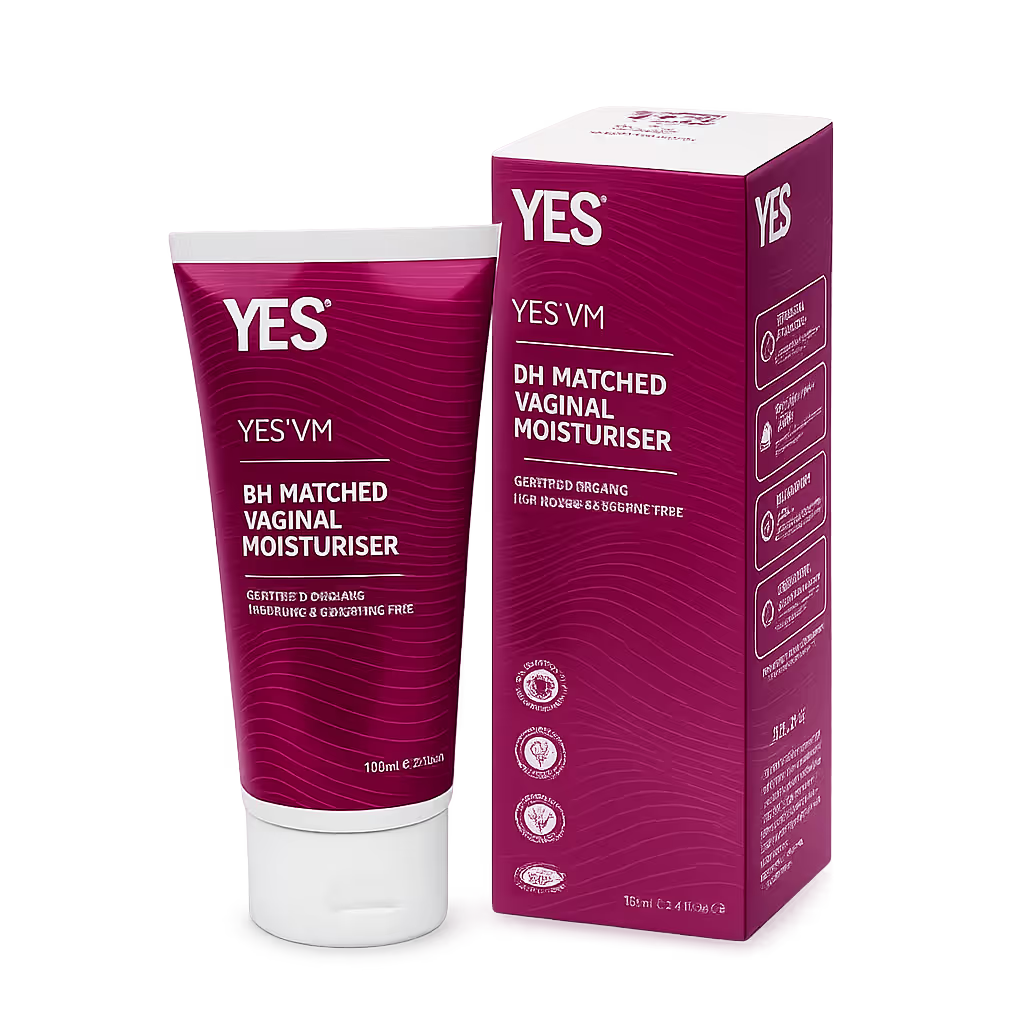
YES VM
Can they prove what they say?
Kind of. Aloe is the only evidence-backed ingredient for vaginal dryness and the studies are very small. Other moisturisers have better evidence and ingredients like hyaluronic acid.
What is it:
YES VM is a non-hormonal vaginal moisturiser for vaginal dryness caused by perimenopause and menopause.
What the clinical trial evidence shows for vaginal moisturisers:
A 2024 systematic review identified only four RCTs on vaginal moisturisers and found they "may improve vaginal dryness" compared to placebo [5]. The certainty of that evidence was rated low, meaning small, short studies with inconsistent methods. The review concluded that long-term efficacy and safety data are lacking for all vaginal moisturisers, not just YES VM [5]. A 2018 meta-analysis found that lubricants and moisturisers were less effective than vaginal oestrogen for sexual function outcomes, though both improved dryness [6].
What the evidence shows for each key ingredient
- Flax extract: A published review found only a trivial effect of oral flaxseed on vaginal tissue in menopause. There's no RCT evidence for topical flax extract as a vaginal moisturising agent [7]. YES VM uses this as a hydrocolloid base, not as a phytoestrogen, but evidence in that specific role is also absent from the literature.
- Aloe vera: One small RCT (n=60) found aloe vera vaginal cream performed comparably to oestrogen cream for vaginal atrophy symptoms over six weeks. This is a promising but very preliminary finding from a single small trial [8]. Another RCT tested a multi-ingredient gel containing aloe vera among other actives, with positive results, but the contribution of aloe vera alone cannot be separated [9].
- Guar gum, locust bean gum, xanthan gum: No published RCTs or systematic reviews exist for these polysaccharides as stand-alone vaginal moisturising ingredients.
What the guidelines say
- NICE (NG23, updated November 2024) recommends offering non-hormonal vaginal moisturisers or lubricants to women with dryness symptoms who prefer a non-hormonal option [1]. YES VM is not named in NICE guidance.
- The British Menopause Society Consensus Statement on GSM recommends non-hormonal vaginal moisturisers (used at least twice weekly) and lubricants (used during sex) as options for relieving dryness, either alongside vaginal oestrogen or DHEA, or on their own, with moisturiser efficacy shown to match local vaginal oestrogen, provided the product's pH and osmolality mimic natural vaginal secretions. [2]
- The British Society for Sexual Medicine explicitly names YES VM as a suitable product, alongside Sylk, noting it is less likely to cause irritation than some alternatives [2]. It also clearly states that moisturisers do not treat the underlying cause of dryness and are suited to mild-to-moderate symptoms [2].
References
[1] NICE. Menopause: Identification and Management. NG23. Updated November 2024. Available at: https://www.nice.org.uk/guidance/ng23. No PMID (clinical guideline).
[2] British Menopause Society. Consensus Statement on Genitourinary Syndrome of Menopause. November 2025. Available at: https://thebms.org.uk/publications/consensus-statements/genitourinary-syndrome-of-menopause-gsm/. No PMID (clinical guideline).
[3] British Society for Sexual Medicine. Position Statement for Management of Genitourinary Syndrome of the Menopause. 2024. Available at: https://bssm.org.uk/wp-content/uploads/2024/03/BSSM-Position-statement-for-management-of-genitourinary-syndrome-of-the-menopause-GSM.pdf. No PMID (clinical guideline).
[4] The Menopause Society (formerly NAMS). Genitourinary Syndrome of Menopause: MenoNote. 2025. Available at: https://menopause.org/wp-content/uploads/for-women/MenoNote-GSM.pdf. No PMID (clinical guideline).
[5] Danan ER et al. Hormonal Treatments and Vaginal Moisturizers for Genitourinary Syndrome of Menopause: A Systematic Review. Annals of Internal Medicine 2024;177(10):1400–1414. PMID: 39250810. https://doi.org/10.7326/ANNALS-24-00610
[6] Pitsouni E et al. Efficacy of vaginal therapies alternative to vaginal estrogens on sexual function and orgasm of menopausal women: A systematic review and meta-analysis of randomized controlled trials. European Journal of Obstetrics, Gynecology, and Reproductive Biology 2018;229:45–56. PMID: 30103082. https://doi.org/10.1016/j.ejogrb.2018.08.008
[7] Dizavandi FR et al. An overview of the phytoestrogen effect on vaginal health and dyspareunia in peri- and post-menopausal women. Post Reproductive Health 2019;25(1):11–20. PMID: 30786797. https://doi.org/10.1177/2053369118823365
[8] Poordast T et al. Aloe Vera: A new treatment for atrophic vaginitis. A randomized double-blinded controlled trial. Journal of Ethnopharmacology 2021;270:113760. PMID: 33383112. https://doi.org/10.1016/j.jep.2020.113760
[9] De Seta F et al. Efficacy and safety of a new vaginal gel for the treatment of symptoms associated with vulvovaginal atrophy in postmenopausal women: A double-blind randomized placebo-controlled study. Maturitas 2021;147:34–40. PMID: 33832645. https://doi.org/10.1016/j.maturitas.2021.03.002
[10] Edwards D, Panay N. Treating vulvovaginal atrophy/genitourinary syndrome of menopause: how important is vaginal lubricant and moisturizer composition? Climacteric 2016;19(2):151–161. PMID: 26407983. https://doi.org/10.3109/13697137.2015.1124259
Water
Phenoxyethanol
Citric acid
Potassium sorbate
Xanthum gum
Sodium chloride
Guar gum
Locust bean gum
Aloe vera
Flax gum

Related Articles
You might be intrested in reading...