
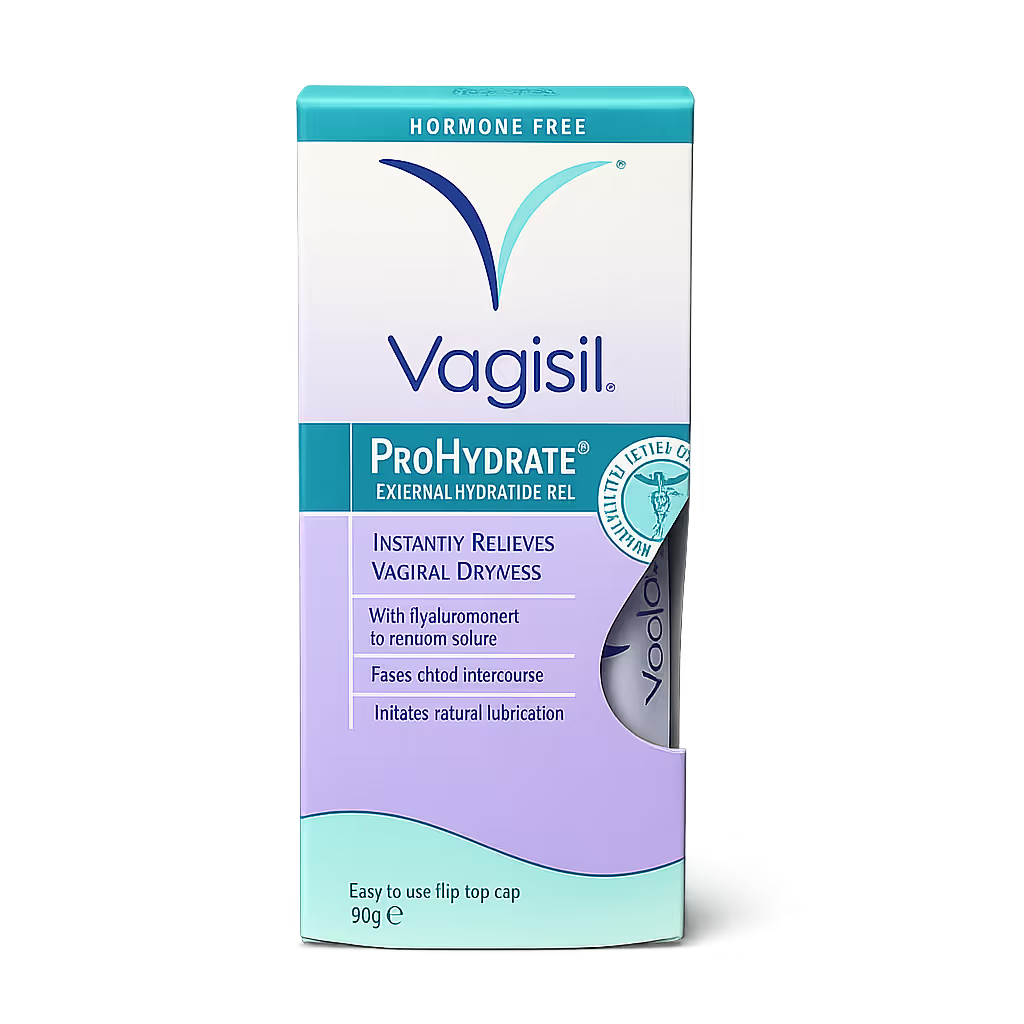
Vagisil ProHydrate Internal Hydrating Gel
Can they prove what they say?
Yes, as long as you're ok with short-term results. ProHydrate's lead ingredient is hyaluronic acid, which has a growing body of trial evidence supporting its use for vaginal dryness. But it won't treat the underlying cause of the dryness--only local oestrogen can do that.
What it is:
A vaginal moisturiser for dryness during perimenopause and menopause.
Clinical trial evidence for the product category
A 2024 systematic review found only 4 RCTs on vaginal moisturisers, rating evidence quality as low [6]. A 2018 RCT of 302 women found a vaginal moisturiser did not significantly outperform placebo at 12 weeks, though all groups improved substantially [7].
Evidence for hyaluronic acid (sodium hyaluronate)
The evidence for hyaluronic acid as a vaginal ingredient is reasonably encouraging. A 2021 systematic review covering 17 studies found it broadly effective for dryness, itching, burning and dyspareunia [8], and several individual RCTs back this up. Across trials comparing HA gel to vaginal oestrogen cream, the two performed similarly [9][11], and in one 3-month RCT it outperformed a plain water-based lubricant [10]. The picture is not entirely consistent. One 2022 RCT found no advantage over polycarbophil gel [12], but taken together the evidence is more solid for HA than for most other non-hormonal vaginal ingredients. Larger, better-designed trials are still needed.
What the guidelines say
There is strong, consistent agreement across UK and international guidelines that non-hormonal vaginal moisturisers are a legitimate and recommended treatment for vaginal dryness. NICE NG23, updated in November 2024, recommends them for women who cannot or prefer not to use vaginal oestrogen [1]. The British Menopause Society's 2025 GSM consensus statement goes a step further, advising use at least twice weekly regardless of sexual activity, and noting that in some studies moisturisers perform comparably to local oestrogen therapy [2]. NAMS (2020) and the BSSM (2024) are equally clear, both placing non-hormonal moisturisers at the top of the treatment ladder for mild symptoms [3][4]. The one consistent gap across all of these guidelines is that none name any specific over-the-counter product, including this one.
References
[1] NICE. Menopause: identification and management (NG23). 2024. Available at: https://www.nice.org.uk/guidance/ng23. No PMID (clinical guideline).
[2] British Menopause Society. Consensus Statement: Genitourinary Syndrome of Menopause (GSM). 2025. Available at: https://thebms.org.uk/publications/consensus-statements/genitourinary-syndrome-of-menopause-gsm/. No PMID (clinical guideline).
[3] Faubion S et al. Menopause 2020;27:976–992. PMID: 32852449. https://pubmed.ncbi.nlm.nih.gov/32852449/
[4] British Society for Sexual Medicine. Position Statement for Management of Genitourinary Syndrome of the Menopause (GSM). 2024. Available at: https://bssm.org.uk/wp-content/uploads/2024/03/BSSM-Position-statement-for-management-of-genitourinary-syndrome-of-the-menopause-GSM.pdf. No PMID (clinical guideline).
[5] Potter N, Panay N et al. Climacteric 2021;24:19–24. PMID: 32990054. https://pubmed.ncbi.nlm.nih.gov/32990054/
[6] Danan E et al. Ann Intern Med 2024;177:1400–1414. PMID: 39250810. https://pubmed.ncbi.nlm.nih.gov/39250810/
[7] Mitchell C et al. JAMA Intern Med 2018;178:681–690. PMID: 29554173. https://pubmed.ncbi.nlm.nih.gov/29554173/
[8] Buzzaccarini G et al. Climacteric 2021;24:560–571. PMID: 33759670. https://pubmed.ncbi.nlm.nih.gov/33759670/
[9] Chen J et al. J Sex Med 2013;10:1575–1584. PMID: 23574713. https://pubmed.ncbi.nlm.nih.gov/23574713/
[10] Nappi R et al. Minerva Obstet Gynecol 2021;74:480–488. PMID: 34096694. https://pubmed.ncbi.nlm.nih.gov/34096694/
[11] Agrawal S et al. Menopause 2024;31:750–755. PMID: 39042017. https://pubmed.ncbi.nlm.nih.gov/39042017/
[12] Cagnacci A et al. Eur J Obstet Gynecol Reprod Biol 2022;270:239–245. PMID: 35131532. https://pubmed.ncbi.nlm.nih.gov/35131532/
Water
Ethylhexylglycerin
Phenethyl alcohol
Hyaluronic acid
Sodium hydroxide
Carbomer Homopolymer Type B
Propanediol
Glycerin

Related Articles
You might be intrested in reading...