
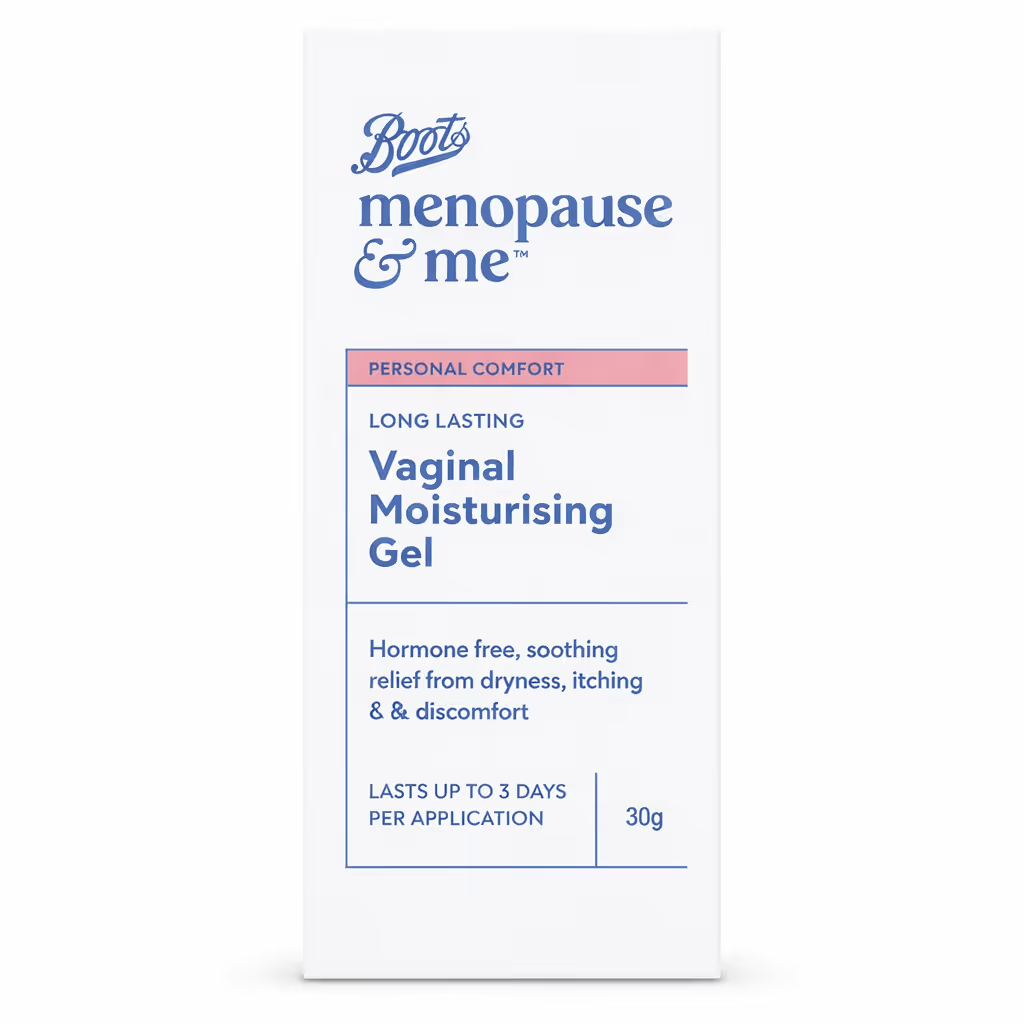
Boots Menopause and Me Vaginal Moisturising Gel
Can they prove what they say?
Yes, as long as you're ok with short-term results. This Gel's lead ingredient is hyaluronic acid, which has a growing body of trial evidence supporting its use for vaginal dryness. But it won't treat the underlying cause of the dryness--only local oestrogen can do that.
What it is:
Boots Menopause & Me Vaginal Moisturising Gel is an over-the-counter gel. Its active ingredient is Hydeal-D, a specially engineered form of hyaluronic acid. This product is identical in formulation to Hyalo Gyn/Hyalofemme, so clinical trials on those products apply directly to the Boots product.
What do the guidelines say?
NICE (2024) recommends vaginal oestrogen as first-line treatment for genitourinary symptoms of menopause [1]. For women who prefer not to use or cannot use oestrogen, NICE recommends non-hormonal vaginal moisturisers or lubricants [1]. For women with a personal history of breast cancer, NICE says to offer non-hormonal moisturisers or lubricants first [1].
The BMS/BSSM Position Statement (2024) states vaginal moisturisers and lubricants should be recommended to women with GSM, either alone or alongside vaginal or systemic hormone therapy [2].
The NAMS 2020 GSM Position Statement recommends moisturisers and lubricants for milder symptoms and as an add-on to prescription treatments [3]. The EMAS clinical guide (2021) notes that vaginal HA preparations showed similar symptom improvement to estriol cream in short-term trials, but emphasises that larger long-term studies are needed [4].
No guideline names this specific product. They recommend the category (vaginal moisturisers) as a whole.
What does the evidence say?
The most relevant trial for this exact product is Chen et al. (2013): an open-label RCT of 144 women comparing hyaluronic acid vaginal gel (Hyalofemme) with estriol cream (Ovestin) over 30 days [5]. Both treatments improved dryness symptoms, with improvement rates of about 84% and 89% respectively, without a statistically significant difference [5]. However, this was open-label (neither patients nor doctors were blinded) and it had no placebo arm.
Nappi et al. (2022) conducted an RCT of 80 women comparing Hyalo Gyn gel with a standard water-based lubricant over 3 months [6]. Both groups showed significant improvements. On the primary outcome (proportion achieving meaningful improvement in dryness), there was no statistically significant difference between Hyalo Gyn and the lubricant. A secondary analysis did favour Hyalo Gyn for absolute change in dryness at 3 months [6].
A 2023 systematic review of RCTs comparing vaginal hyaluronic acid to vaginal oestrogen found HA was effective at relieving symptoms but that overall, oestrogen appeared to be somewhat superior for some outcomes like vaginal maturation and pH [9].
A 2024 systematic review in the Annals of Internal Medicine found that vaginal moisturisers may improve dryness, but rated the evidence as low certainty [10].
References
[1] National Institute for Health and Care Excellence (NICE). Menopause: identification and management (NG23). 2024. Available at: https://www.nice.org.uk/guidance/ng23. No PMID (clinical guideline).
[2] British Menopause Society / British Society for Sexual Medicine. Position Statement for Management of Genitourinary Syndrome of Menopause (GSM). 2024. Available at: https://bssm.org.uk/wp-content/uploads/2024/03/BSSM-Position-statement-for-management-of-genitourinary-syndrome-of-the-menopause-GSM.pdf. No PMID (clinical guideline).
[3] The NAMS 2020 GSM Position Statement Editorial Panel. The 2020 genitourinary syndrome of menopause position statement of The North American Menopause Society. Menopause 2020;27(9):976-992. PMID: 32852449. https://pubmed.ncbi.nlm.nih.gov/32852449/
[4] Balica A et al. Topical estrogens and non-hormonal preparations for postmenopausal vulvovaginal atrophy: An EMAS clinical guide. Maturitas 2021;148:18-26. Available at: https://www.maturitas.org/article/S0378-5122(21)00061-X/fulltext. No PMID provided in source (clinical guideline).
[5] Chen J et al. Evaluation of the efficacy and safety of hyaluronic acid vaginal gel to ease vaginal dryness: a multicenter, randomized, controlled, open-label, parallel-group, clinical trial. J Sex Med 2013;10:1575-1584. PMID: 23574713. https://pubmed.ncbi.nlm.nih.gov/23574713/
[6] Nappi RE et al. Treatment of vulvo-vaginal atrophy with hyaluronate-based gel: a randomized controlled study. Minerva Obstet Gynecol 2022;74(6):480-488. PMID: 34096694. https://pubmed.ncbi.nlm.nih.gov/34096694/
[7] Carter J et al. A single-arm clinical trial investigating the effectiveness of a non-hormonal, hyaluronic acid-based vaginal moisturizer in endometrial cancer survivors. Gynecol Oncol 2020;158(2):366-374. PMID: 32522420. https://pubmed.ncbi.nlm.nih.gov/32522420/
[8] Carter J et al. A single-arm, prospective trial investigating the effectiveness of a non-hormonal vaginal moisturizer containing hyaluronic acid in postmenopausal cancer survivors. Support Care Cancer 2021;29:311-322. PMID: 32358778. https://pubmed.ncbi.nlm.nih.gov/32358778/
[9] Aly T et al. Comparison of the efficacy of vaginal hyaluronic acid to estrogen for the treatment of vaginal atrophy in postmenopausal women: a systematic review. Cureus 2023;15(9):e45755. PMID: 37868468. https://pubmed.ncbi.nlm.nih.gov/37868468/
[10] Ensrud KE et al. Hormonal treatments and vaginal moisturizers for genitourinary syndrome of menopause: a systematic review. Ann Intern Med 2024;177(10):1400-1414. PMID: 39250754. https://pubmed.ncbi.nlm.nih.gov/39250754/
Hyaluronic acid
Propylene glycol
Methylpropandiol
1,2-Hexanediol
Caprylyl glycol
Water

Related Articles
You might be intrested in reading...