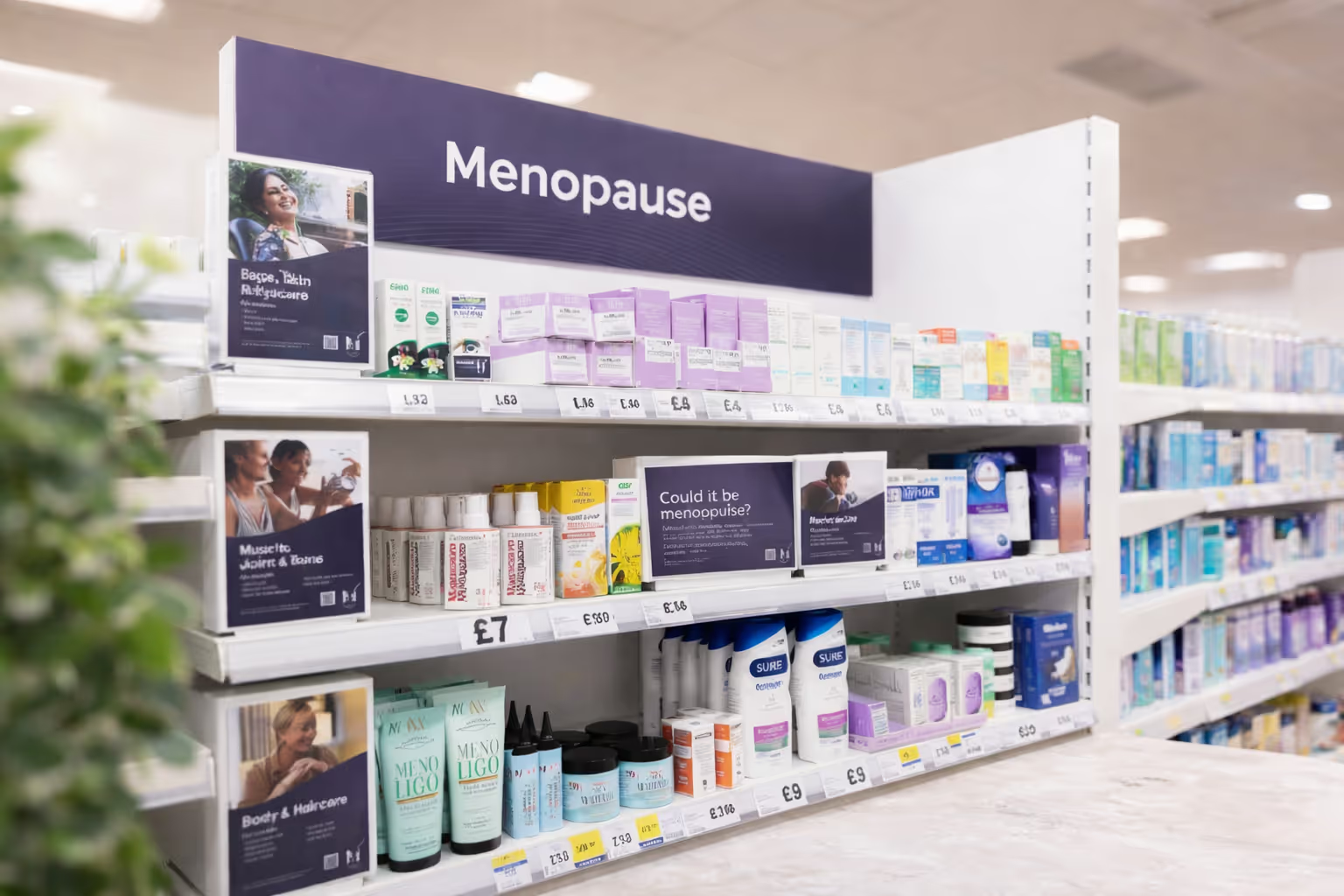

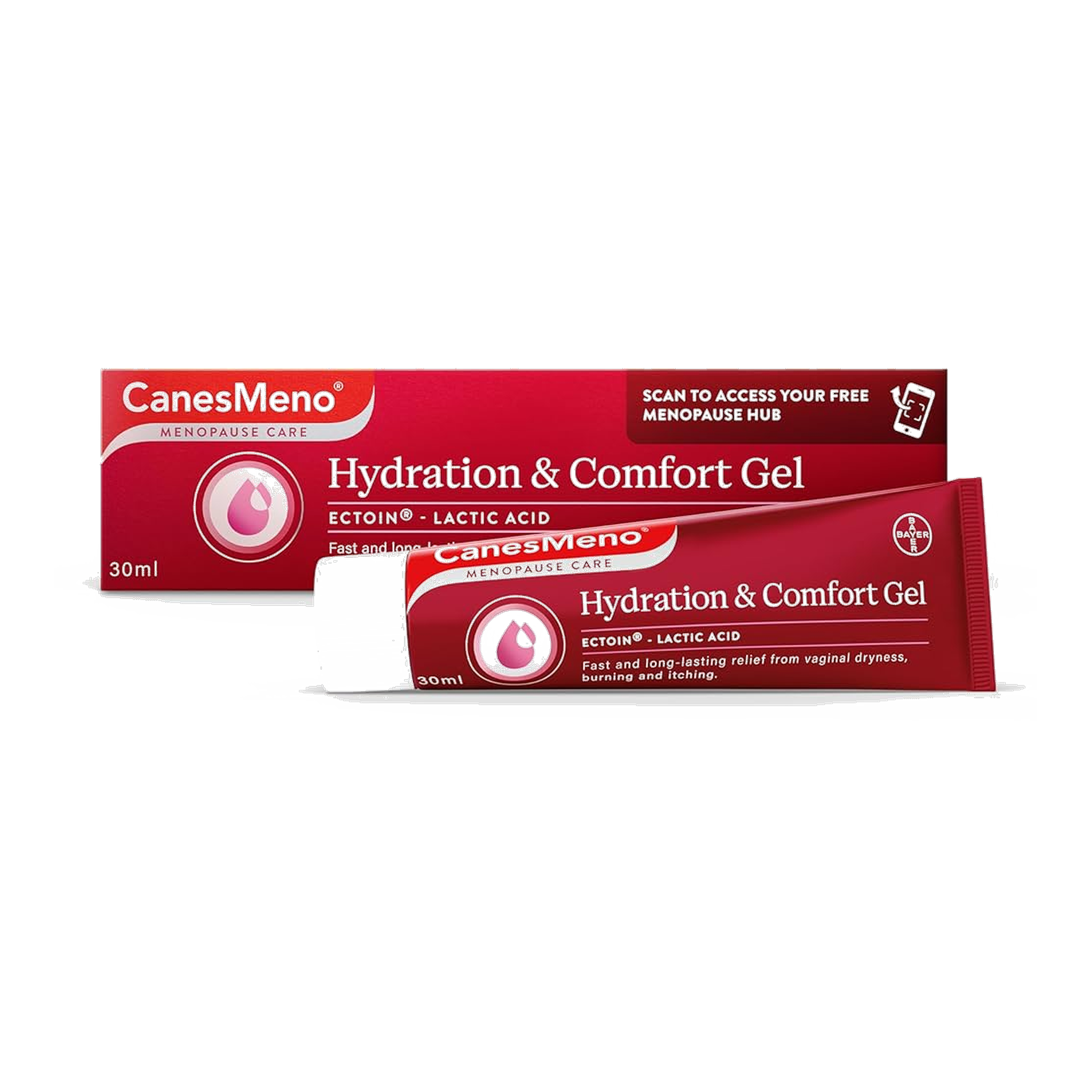
CanesMeno Hydration & Comfort Gel
Can they prove what they say?
CanesMeno gel claims fast, lasting relief for menopausal dryness, but its headline ingredient has never been tested in a vaginal trial, and a better-evidenced non-hormonal option is already sitting next to it on the shelf.
What is it:
This is a non-hormonal vaginal moisturiser for vaginal dryness, burning, itching and painful sex caused by menopausal vaginal atrophy, also called GSM [1][2]
Marketing claims
Hormone-free CE-marked medical device for vaginal atrophy symptoms in menopause:
- Fast, long-lasting relief from vaginal dryness, burning and itching for up to five days per application
- Contains Ectoin® as the named active
- Supports the regeneration process of the irritated vaginal lining and prevents further dehydration
- Maintains vaginal pH balance
- Reduces pain during sexual intercourse
- Suitable for daily use, hormone-free, can be used alongside HRT
- Compatible with latex, polyisoprene and polyurethane condoms
- Free from fragrance, dyestuff, mineral oils and alcohol
- "Effects based on 100% natural ingredients"
- Recommended at the onset of first symptoms of vaginal discomfort
What do the guidelines say
- NICE NG23 (2015, updated November 2024) says vaginal oestrogen should be offered first-line for GSM. Non-hormonal moisturisers or lubricants should be offered to women with a personal history of breast cancer, and considered for women who cannot use, or prefer not to use, vaginal oestrogen. Moisturisers can also be combined with vaginal oestrogen [1].
- British Menopause Society Menopause Practice Standards (March 2026) states women with genitourinary symptoms can use moisturisers and lubricants alone or with vaginal oestrogen [2].
- The Menopause Society (formerly NAMS) 2020 GSM Position Statement lists non-hormonal lubricants and moisturisers as appropriate first-line options for mild symptoms or when hormones are not wanted or safe [3].
- AUA/SUFU/AUGS 2025 GSM guideline also supports non-hormonal moisturisers and lubricants for vaginal dryness and painful sex [11].
- None of these guidelines name CanesMeno® or Ectoin specifically. They support the category.
What does the evidence say
- For the product category (non-hormonal vaginal moisturisers): the 2024 systematic review that underpinned NICE found only four moisturiser RCTs meeting inclusion criteria. It concluded moisturisers may improve vaginal dryness, but with low certainty [12]. The Cochrane review of local oestrogen confirms oestrogen efficacy but does not establish moisturiser efficacy [13].
- The largest, best-quality moisturiser RCT (Mitchell 2018, n=302) compared a vaginal moisturiser, low-dose vaginal estradiol, and placebo gel over 12 weeks. Neither the moisturiser nor the estradiol was better than placebo gel at reducing the most bothersome symptom [14]. This suggests much of the benefit women report from moisturisers may come from the gel base (lubrication, hydration, regular self-care) rather than any specific active.
- For Ectoin in the wider clinical literature, there is a real but off-target body of evidence:
- A 2022 systematic review of topical ectoine in inflammatory skin disease pooled six studies, mostly atopic dermatitis, showing ectoine creams improved skin dryness and itch and were well tolerated [4]. The first author is employed by Bitop AG, the company that owns the Ectoin® trademark, which should be flagged.
- A 2021 review of 14 clinical trials concluded ectoine-containing nasal sprays were non-inferior to standard treatments for mild-to-moderate allergic rhinitis [5].
- There are individual RCTs of ectoine in dry eye disease, radiation dermatitis after breast cancer radiotherapy, and acute viral pharyngitis [6].
- However, none of this evidence is in vaginal tissue, in menopausal women, or for vaginal atrophy. Skin barrier, nasal mucosa, ocular surface and vaginal epithelium differ in cell type, hormonal regulation, microbiome and pathology. The osmolyte mechanism (water binding, membrane stabilisation) is biologically plausible across tissues, but plausibility does not equal evidence, and no published RCT has tested ectoine intravaginally.
- For lactic acid and sodium lactate in the product: these buffer to a low pH that mimics premenopausal vaginal fluid, which is biologically sensible, but no RCT or SR isolates these ingredients for symptom relief in menopausal vaginal atrophy.
- For the remaining ingredients (hydroxyethylcellulose, propylene glycol, sodium benzoate, water): these are standard gel-base and preservative components, not active ingredients with menopause trial data.
Claims that go beyond the evidence
- "Up to five days" of relief per application is a product-specific durability claim. There is no peer-reviewed trial of this product to verify it. If Bayer holds CE-mark dossier data, it isn't in the public domain.
- "Supports the regeneration process" of the vaginal lining is a tissue-level efficacy claim. Ectoin has cell-protective effects in lab models and in skin, but no vaginal trial has shown lining regeneration in women.
- "Effects based on 100% natural ingredients" is misleading. Propylene glycol, hydroxyethylcellulose and sodium benzoate are synthetic. Ectoine occurs naturally in microbes but is manufactured biotechnologically. "Nature-derived" or "free from fragrance and hormones" would be defensible; "100% natural" is not.
- "Maintains pH balance" is plausible given the lactic acid and sodium lactate buffer, but the clinical consequence of that for symptom relief in this specific product has not been demonstrated.
Bottom line
If you have vaginal dryness, burning or pain during sex from menopause, a non-hormonal vaginal moisturiser is a reasonable thing to try, and the guidelines back the category. CanesMeno fits the category: it's hormone-free, condom-safe, and you can use it alongside HRT or vaginal oestrogen. The honest caveats are three. First, the brand's headline ingredient ectoine has never been tested in a published vaginal trial, and the product itself has no peer-reviewed evidence. Second, the best evidence on moisturisers in general is modest and low-certainty, and the largest placebo-controlled trial found a moisturiser did not beat a plain gel. Third, if you're choosing a non-hormonal option specifically on the strength of the evidence, a hyaluronic acid-based moisturiser has substantially more clinical trial data behind it for this exact use. CanesMeno may well still work for you, and many women will find it does, but the marketing implies a level of product-specific evidence that does not yet exist in the public literature. Vaginal oestrogen remains the strongest-evidence treatment NICE recommends for most women who can use it.
References
- NICE. Menopause: identification and management. NICE Guideline NG23. 2015 (updated November 2024). Available at: https://www.nice.org.uk/guidance/ng23. No PMID (clinical guideline).
- British Menopause Society. Menopause Practice Standards. March 2026. Available at: https://thebms.org.uk/wp-content/uploads/2026/03/NEW-BMS-Menopause-Practice-Standards-MAR2026-B.pdf. No PMID (clinical guideline).
- The NAMS 2020 GSM Position Statement Editorial Panel. The 2020 genitourinary syndrome of menopause position statement of The North American Menopause Society. Menopause 2020;27(9):976-992. PMID: 32852449. https://pubmed.ncbi.nlm.nih.gov/32852449/
- Kauth M, Trusova OV. Topical Ectoine Application in Children and Adults to Treat Inflammatory Diseases Associated with an Impaired Skin Barrier: A Systematic Review. Dermatol Ther (Heidelb) 2022;12(2):295-313. PMID: 35038127. https://pubmed.ncbi.nlm.nih.gov/35038127/
- Bilstein A, Werkhäuser N, Rybachuk A, Mösges R. The Effectiveness of the Bacteria Derived Extremolyte Ectoine for the Treatment of Allergic Rhinitis. Biomed Res Int 2021;2021:5562623. PMID: 34159193. https://pubmed.ncbi.nlm.nih.gov/34159193/
- Abd Elazim NE, Awad SM, El-Naggar MS, Mohamed RH. Topical Ectoin Versus Topical Dexpanthenol for Managing Acute Radiodermatitis Associated With Breast Cancer Radiotherapy: A Randomized Double-Blind Study. Dermatitis 2023;34(6):516-524. PMID: 37792331. https://pubmed.ncbi.nlm.nih.gov/37792331/
- Albalawi NS, Almohammadi MA, Albalawi AR. Comparison of the Efficacy of Vaginal Hyaluronic Acid to Estrogen for the Treatment of Vaginal Atrophy in Postmenopausal Women: A Systematic Review. Cureus 2023;15(8):e44191. PMID: 37767255. https://pubmed.ncbi.nlm.nih.gov/37767255/
- dos Santos CCM, Uggioni MLR, Colonetti T et al. Hyaluronic Acid in Postmenopause Vaginal Atrophy: A Systematic Review. J Sex Med 2021;18(1):156-166. PMID: 33293236. https://pubmed.ncbi.nlm.nih.gov/33293236/
- Dahab M, Ramasamy K, Ibrahim B. Hyaluronic acid for vaginal health and quality of life in postmenopausal women: A systematic review and meta-analysis of randomized controlled trials. Int J Gynaecol Obstet 2026. PMID: 41773428. https://pubmed.ncbi.nlm.nih.gov/41773428/
- Edwards D, Panay N. Treating vulvovaginal atrophy/genitourinary syndrome of menopause: how important is vaginal lubricant and moisturizer composition? Climacteric 2016;19(2):151-161. PMID: 26707589. https://pubmed.ncbi.nlm.nih.gov/26707589/
- American Urological Association, SUFU and AUGS. Genitourinary Syndrome of Menopause Guideline. 2025. Available at: https://www.auanet.org/guidelines-and-quality/guidelines/gsm-guideline. No PMID (clinical guideline).
- Danan ER, Sowerby C, Ullman KE et al. Hormonal Treatments and Vaginal Moisturizers for Genitourinary Syndrome of Menopause: A Systematic Review. Ann Intern Med 2024;177(10):1400-1414. PMID: 39250810. https://pubmed.ncbi.nlm.nih.gov/39250810/
- Lethaby A, Ayeleke RO, Roberts H. Local oestrogen for vaginal atrophy in postmenopausal women. Cochrane Database Syst Rev 2016;8:CD001500. PMID: 27577677. https://pubmed.ncbi.nlm.nih.gov/27577677/
- Mitchell CM, Reed SD, Diem S et al. Efficacy of Vaginal Estradiol or Vaginal Moisturizer vs Placebo for Treating Postmenopausal Vulvovaginal Symptoms: A Randomized Clinical Trial. JAMA Intern Med 2018;178(5):681-690. PMID: 29554173. https://pubmed.ncbi.nlm.nih.gov/29554173/
Ectoin
Hydroxyethylcellulose
Lactic acid
Sodium Benzoate
Sodium lactate
Propylene glycol
Water

Related Articles
You might be intrested in reading...