
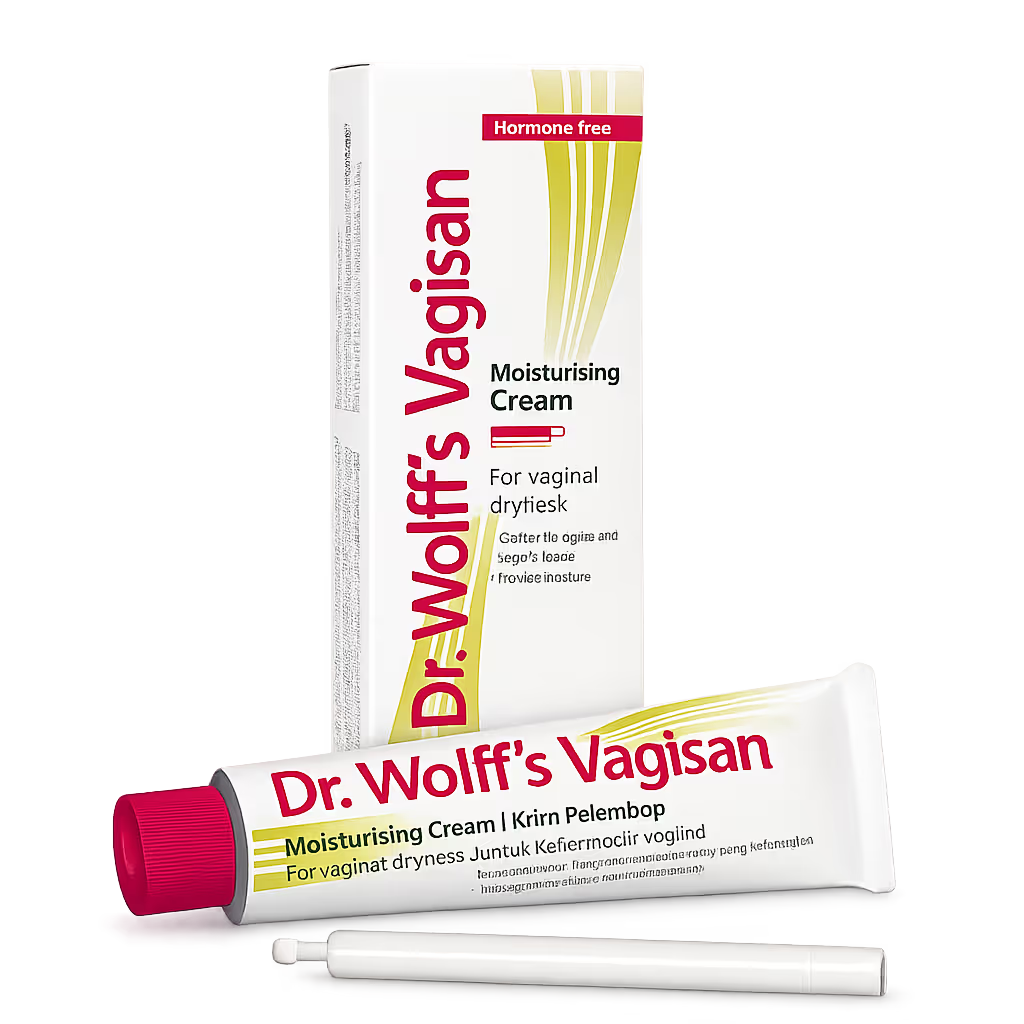
Dr. Wolff's Vagisan Moisturising Cream
Can they prove what they say?
Yes, as long as you're ok with short-term results. This cream has more clinical data behind it than most vaginal moisturisers, although the improvements are modest. But it won't treat the underlying cause of the dryness--only local oestrogen can do that.
What it is:
An over-the-counter cream for vaginal dryness
What do the guidelines say?
Four major guidelines cover this product category. None names Vagisan specifically. All recommend vaginal moisturisers as an option, but they differ on where moisturisers sit in the treatment pathway.
NICE NG23 (updated November 2024) [1]: Vaginal oestrogen is the first-line treatment. Non-hormonal moisturisers or lubricants are a "consider" option for women who cannot or prefer not to use oestrogen. For women with a history of breast cancer, non-hormonal options should be offered first.
BMS/BSSM Position Statement on GSM (2024) [2]: Vaginal moisturisers and lubricants should be recommended to women with GSM, either alone or alongside hormone therapy.
NAMS GSM Position Statement (2020) [3]: For milder symptoms, non-hormonal moisturisers used regularly (several times a week) and lubricants during sex are first-line.
AUA/SUFU/AUGS Guideline (2025) [4]: Recommends vaginal moisturisers and/or lubricants, alone or combined with other treatments, for vaginal dryness and painful sex. Graded as a Moderate Recommendation with Grade C evidence.
In short: every major guideline supports the category this product sits in, particularly for milder symptoms or where hormones are not suitable. But vaginal oestrogen remains the stronger-evidence option for moderate to severe GSM.
What does the evidence say?
This specific product has been tested in two RCTs, both funded by the manufacturer (Dr. August Wolff):
- An open-label crossover RCT in 117 women compared Vagisan cream with a non-hormonal vaginal gel over 12 weeks. Both reduced symptoms of dryness, itching and burning. The cream scored better on symptoms and tolerability [5].
- An open-label parallel RCT in 172 women compared Vagisan cream with 0.1% estriol cream (a prescription hormonal product) over 43 days. The cream was non-inferior to estriol for dryness, itching, burning and pain. Women with severe symptoms did better on the estriol [6].
- A third, non-RCT study in 128 breast cancer patients found it improved dryness symptoms, but without a control group this carries less weight [7].
Key limitation: neither RCT included a placebo group, so we cannot separate the cream's effect from the placebo/regular-use effect, which is known to be large in this area.
The product category (vaginal moisturisers generally) has limited high-quality evidence:
- A 2024 systematic review in the Annals of Internal Medicine found only 4 RCTs for vaginal moisturisers out of 46 GSM trials reviewed. The overall certainty of evidence was rated low to very low [8].
- The best placebo-controlled RCT (Mitchell 2018, 302 women) found that neither vaginal estradiol nor a moisturiser (Replens, not Vagisan) was significantly better than placebo at reducing the most bothersome symptom. All groups improved substantially [9]. This is a different product, but it raises important questions about the whole category.
Individual ingredients: No single ingredient in this formulation has standalone RCT evidence for vaginal dryness. Lactic acid and sodium lactate are included to set the pH at 4.5 (matching the healthy vaginal environment, in line with WHO recommendations), not as active treatments. The remaining ingredients are standard emollients, emulsifiers and a preservative. The product works as a whole formulation, not through any single active ingredient.
References
[1] National Institute for Health and Care Excellence (NICE). Menopause: identification and management. NICE Guideline NG23 (updated November 2024). Available at: https://www.nice.org.uk/guidance/ng23/chapter/recommendations. No PMID (clinical guideline).
[2] British Menopause Society / British Society for Sexual Medicine. Position Statement for Management of Genitourinary Syndrome of the Menopause (GSM). 2024. Available at: https://bssm.org.uk/wp-content/uploads/2024/03/BSSM-Position-statement-for-management-of-genitourinary-syndrome-of-the-menopause-GSM.pdf. No PMID (clinical guideline).
[3] Faubion S et al. The 2020 genitourinary syndrome of menopause position statement of The North American Menopause Society. Menopause 2020;27(9):976-992. PMID: 32852449. https://pubmed.ncbi.nlm.nih.gov/32852449/
[4] American Urological Association / Society of Urodynamics, Female Pelvic Medicine and Urogenital Reconstruction / American Urogynecologic Society. Genitourinary Syndrome of Menopause: AUA/SUFU/AUGS Guideline. 2025. Available at: https://www.auanet.org/guidelines-and-quality/guidelines/genitourinary-syndrome-of-menopause. No PMID (clinical guideline).
[5] Stute P et al. Efficacy and safety of non-hormonal remedies for vaginal dryness: open, prospective, randomized trial. Climacteric 2015;18(4):582-589. PMID: 25845406. https://pubmed.ncbi.nlm.nih.gov/25845406/
[6] Garcia de Arriba S et al. Vaginal hormone-free moisturising cream is not inferior to an estriol cream for treating symptoms of vulvovaginal atrophy: Prospective, randomised study. PLoS One 2022;17(5):e0266633. PMID: 35587510. https://pubmed.ncbi.nlm.nih.gov/35587510/
[7] Chatsiproios D et al. Topical treatment of vaginal dryness with a non-hormonal cream in women undergoing breast cancer treatment: an open prospective multicenter study. PLoS One 2019;14(1):e0210967. PMID: 30682076. https://pubmed.ncbi.nlm.nih.gov/30682076/
[8] Danan E et al. Hormonal Treatments and Vaginal Moisturizers for Genitourinary Syndrome of Menopause: A Systematic Review. Ann Intern Med 2024;177(10):1400-1414. PMID: 39250810. https://pubmed.ncbi.nlm.nih.gov/39250810/
[9] Mitchell C et al. Efficacy of Vaginal Estradiol or Vaginal Moisturizer vs Placebo for Treating Postmenopausal Vulvovaginal Symptoms: A Randomized Clinical Trial. JAMA Intern Med 2018;178(5):681-690. PMID: 29554173. https://pubmed.ncbi.nlm.nih.gov/29554173/
Water
Benzyl alcohol
Cetearyl alcohol
Cetyl palmitate
Lactic acid
Ocytldodecanol
Polysorbate 60
Sodium lactate
Sorbitan stearate

Related Articles
You might be intrested in reading...