
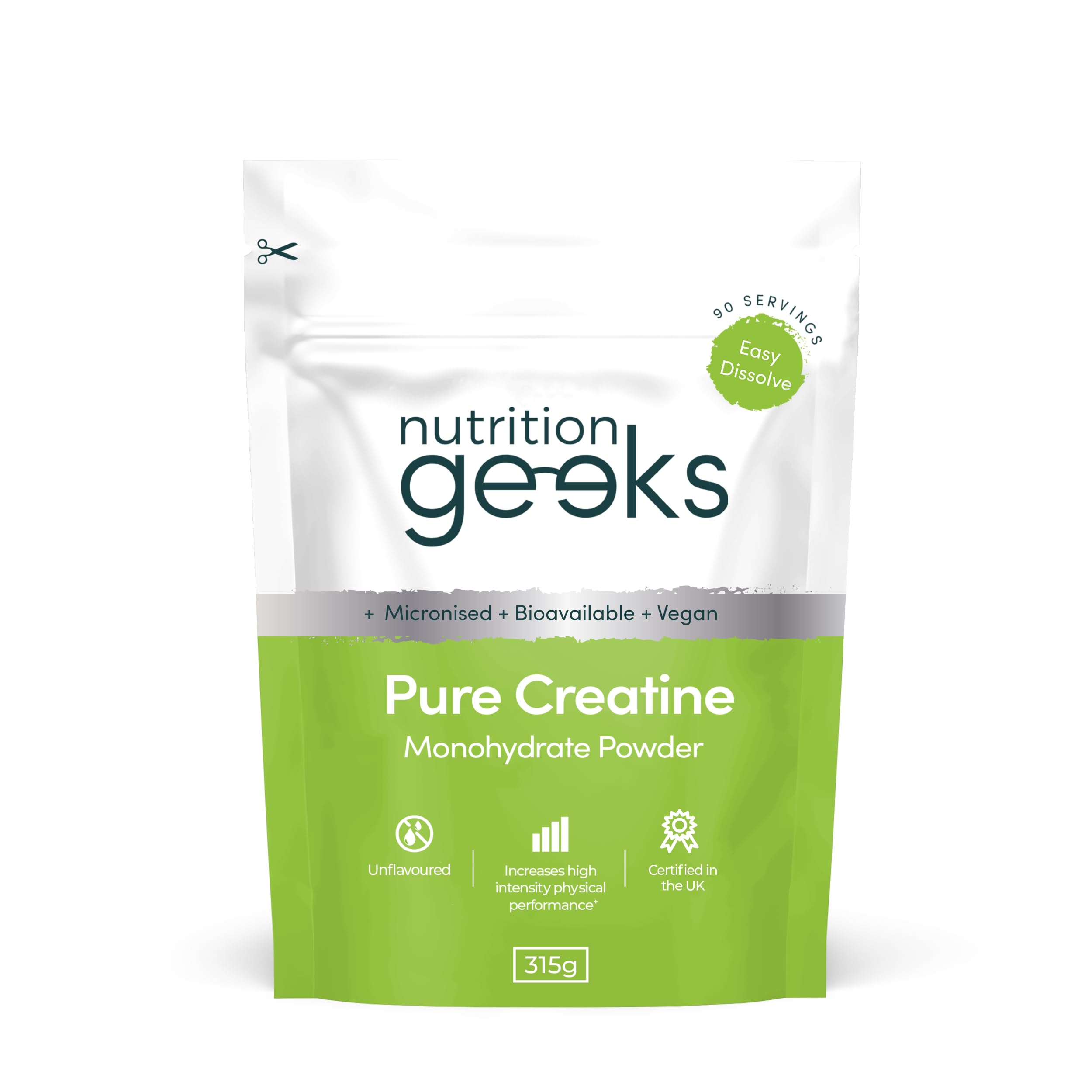
Nutrition Geeks Pure Creatine Monohydrate
Can they prove what they say?
Some of it. If you're doing resistance training, or thinking about starting it, creatine monohydrate is probably the supplement with the strongest evidence base for supporting muscle strength in this life stage. The key element--creatine monohydrate works alongside resistance training, not instead of it, and this brand doesn't make that clear.



What is it?
Creatine monohydrate is a well-studied supplement that supports muscle strength and energy. It occurs naturally in the body and in red meat and fish.
What does the evidence say?
Muscle strength and mass
A 2021 systematic review and meta-analysis of 10 RCTs in older females found that creatine combined with resistance training produced significant gains in upper-body strength, and both upper- and lower-body strength when training lasted at least 24 weeks [2]. A 2025 meta-analysis of 69 RCTs found significant improvements in bench press and squat strength for adults overall, but subgroup analysis by sex showed these effects were significant in males and not in females for several key outcomes, including leg press and handgrip strength [8]. Effects in women are real but more variable than in men, and most trials have small sample sizes and short durations.
Bone density
This is where the advertising claim "bone density" requires scrutiny. A 12-month RCT in 47 postmenopausal women found that creatine plus resistance training slowed femoral neck bone mineral density loss compared to placebo and improved a predictor of bone bending strength at the femoral shaft [3]. A larger 2-year RCT in 237 postmenopausal women found no significant effect on bone mineral density at the femoral neck, total hip, or lumbar spine. Creatine did maintain some structural bone geometry properties at the femoral neck and improved walking speed [4]. The claim "bone density" as a headline benefit is not supported by the trial evidence. Structural bone properties may be modestly preserved. These are not the same thing.
Cognitive function and brain fog
A 2023 systematic review and meta-analysis of 10 RCTs found that creatine supplementation improved memory compared to placebo in healthy adults, with the strongest effect in older adults aged 66-76 [5]. These were not menopause-specific trials and none focused on brain fog as a menopausal symptom. The ad's "brain energy" and the product page's "reduces brain fog" claims are plausible given the direction of the evidence, but they go beyond what has been tested in this population.
The advertising headline claim: "Creatine levels drop fast during menopause"
This requires specific attention because it is the central purchase driver in the paid advertising. The claim implies a well-established, quantified physiological fact. It is not. The most relevant scientific review of creatine in women across the lifespan (published 2025) explicitly states that, to the authors' knowledge, there are no studies examining creatine in perimenopausal women. The same paper notes that studies in postmenopausal women have used participants with a mean age of 57, which overlaps with the upper range of perimenopause but does not represent it directly [7]. The paper referenced visually in the ad is a narrative review, a study type that Prove It Health excludes from its evidence standard. Citing it as scientific backing for a specific factual claim is misleading.
Safety
A 2020 systematic review and meta-analysis specifically examining adverse outcomes in females found no deaths, no serious adverse events, and no significant differences in weight gain, gastrointestinal events, or kidney and liver function between creatine and placebo groups [6]. The claim of "zero bloating" from micronisation is marketing language. Mild gastrointestinal effects are possible with any creatine formulation, though they tend to be dose-dependent and mild.
What do the guidelines say?
No UK guideline currently names or recommends creatine for perimenopausal or menopausal women. NICE NG23 (updated November 2024) [9] and the British Menopause Society guidelines (2024) [10] focus on HRT and licensed treatments and do not reference creatine. Creatine is not classified as a medicine in the UK.
The ISSN 2017 position stand concludes that creatine monohydrate is the most effective ergogenic supplement for high-intensity exercise capacity and lean body mass in training, and that supplementation is safe and well-tolerated in healthy individuals [1]. It also explicitly notes that the majority of research has been conducted in men, and that women may not see equivalent gains in strength or muscle mass [1]. No NAMS, EMAS, IMS, or RCOG guidance on creatine exists at the time of this review.
References
- Kreider R B et al. J Int Soc Sports Nutr 2017;14:18. No PMID (position stand). Available at: https://doi.org/10.1186/s12970-017-0173-z
- Dos Santos E E P et al. Nutrients 2021;13(11). PMID: 34836013. https://doi.org/10.3390/nu13113757
- Chilibeck P D et al. Med Sci Sports Exerc 2015;47(8):1587-95. PMID: 25386713. https://doi.org/10.1249/MSS.0000000000000571
- Chilibeck P D et al. Med Sci Sports Exerc 2023;55(10):1750-1760. PMID: 37144634. https://doi.org/10.1249/MSS.0000000000003202
- Prokopidis K et al. Nutr Rev 2023;81(4):416-427. PMID: 35984306. https://doi.org/10.1093/nutrit/nuac064
- de Guingand D L et al. Nutrients 2020;12(6). PMID: 32549301. https://doi.org/10.3390/nu12061780
- Smith-Ryan A E et al. J Int Soc Sports Nutr 2025. PMID: 40371844. Available at: https://pubmed.ncbi.nlm.nih.gov/40371844/
- Kazeminasab F et al. Nutrients 2025;17(17). PMID: 40944139. https://doi.org/10.3390/nu17172748
- NICE. Menopause: diagnosis and management. NG23. Updated November 2024. No PMID (clinical guideline). Available at: https://www.nice.org.uk/guidance/ng23
- British Menopause Society. BMS Menopause and Perimenopause Recommendations. 2024. No PMID (clinical guideline). Available at: https://thebms.org.uk/
Creatine Monohydrate

Related Articles
You might be intrested in reading...