
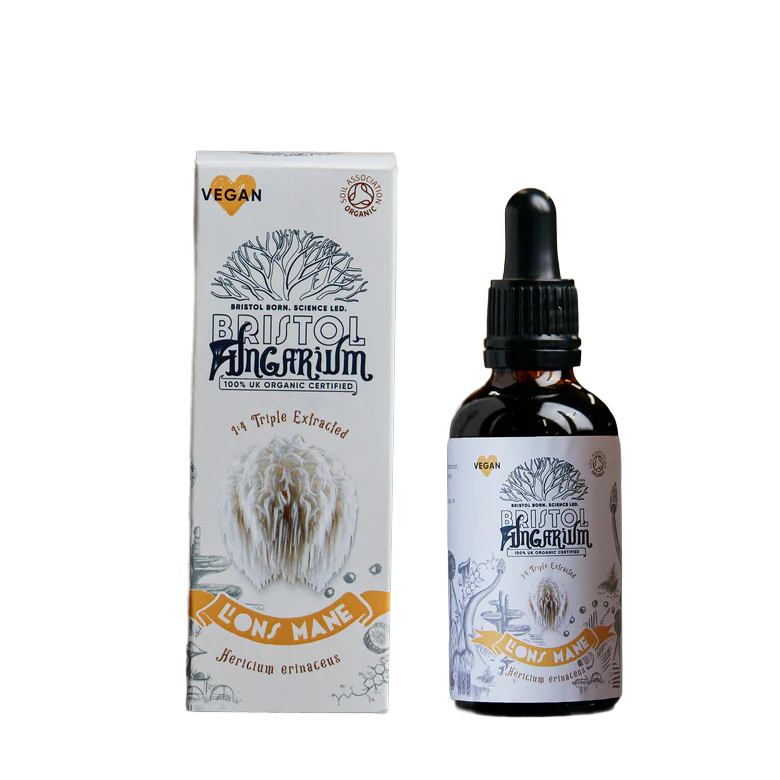
Bristol Fungarium Lion's Mane Tincture
Can they prove what they say?
A bit. There is some early clinical evidence that lion's mane may help with mood and anxiety, and modest evidence for cognitive support in older adults. But the evidence is thin, the studies are small, and this specific tincture has never been robustly tested.

What it is
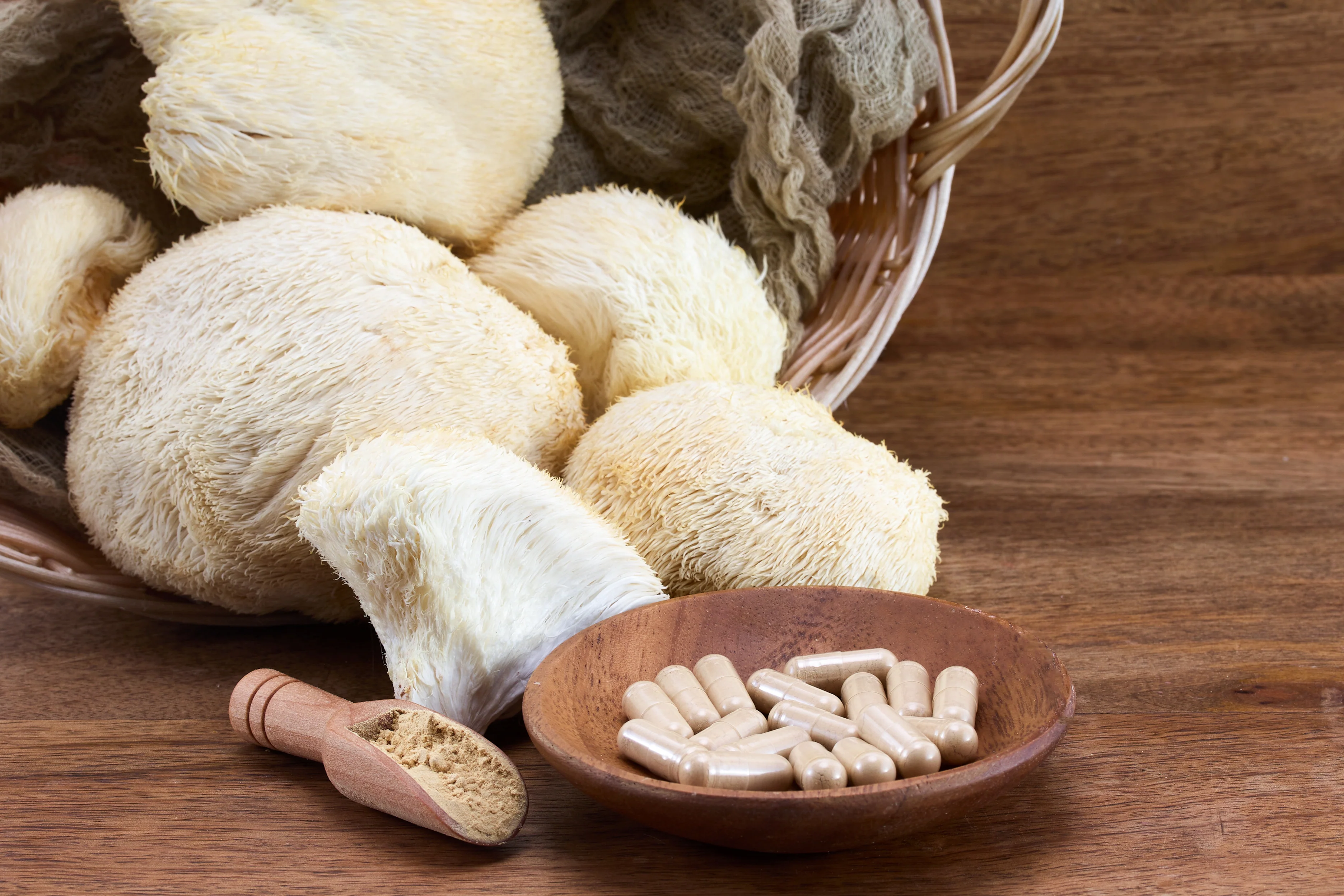
A food supplement tincture made from lion's mane mushroom (Hericium erinaceus), marketed for cognitive function, focus, and gut health. Not specifically marketed as a menopause product, but appears in the brand's Women's Support Bundle.
What does the evidence say for the key ingredient (Hericium erinaceus)?
- Cognitive function in mild impairment: Two small RCTs in older adults with mild cognitive impairment [4][5] found improvements in standardised cognitive scores with HE supplementation, though effects reversed after stopping. One pilot RCT in Alzheimer's patients [6] found similar benefits but was funded by the manufacturer.
- Cognition in healthy adults: Two recent small RCTs [7][8] found some acute improvements in attention, reaction time, and task performance in healthy young adults. Results are promising but neither study involved menopausal women.
- Depression and anxiety specifically in menopausal women: One small RCT (n=30) [9] found HE reduced depression and anxiety scores compared to placebo over 4 weeks. Importantly, overall menopausal symptom scores (Kupperman Menopausal Index) did not improve significantly, suggesting the main benefit — if real — may be on psychological wellbeing rather than vasomotor or other physical symptoms.
- Animal models of menopause: A 2022 animal study [10] found HE may reduce depressive-like behaviour in oestrogen-deficient rats, possibly via ERβ activation rather than ERα, which is a meaningful distinction for breast cancer risk — but this remains animal data only.
What does the clinical evidence say for the product category (functional mushroom supplements)?
A 2025 systematic review of 26 studies on HE as a supplement [3] found evidence supporting modest cognitive benefits, reduced anxiety and depression, and improved gut microbiota diversity. The review included 5 RCTs, though these varied in population, dose, and duration. The overall quality of the evidence base is promising but not robust — trials are small, short, and methodology isn't consistent.
What do guidelines say?
NICE NG23 (November 2024) [1] does not name lion's mane or any mushroom supplement. It says women who want to try complementary therapies should be told that the safety, quality, and purity of unregulated preparations may be unknown. The BMS Consensus Statement on Non-Hormonal Treatments (September 2024) [2] also does not mention lion's mane.
What are the key limitations?
All human trials used powder or tablet forms — not tinctures. No trial has tested this product or dose form. All trials are small. The only menopause-specific human trial had just 30 participants and lasted 4 weeks. The brand's cited UWE research is cell-line work only, not a clinical trial.
References
[1] National Institute for Health and Care Excellence (NICE). Menopause: Identification and Management (NG23). Published November 2015; updated November 2024. Available at: https://www.nice.org.uk/guidance/ng23. No PMID (clinical guideline).
[2] British Menopause Society (BMS). Consensus Statement: Non-Hormonal-Based Treatments for Menopausal Symptoms. September 2024. Available at: https://thebms.org.uk/wp-content/uploads/2024/09/04-BMS-ConsensusStatement-Non-hormonal-based-treatments-SEPT2024-A.pdf. No PMID (clinical guideline).
[3] Menon A, Jalal A, Arshad Z et al. Benefits, side effects, and uses of Hericium erinaceus as a supplement: a systematic review. Frontiers in Nutrition 2025;12:1641246. PMID: 40959699. https://doi.org/10.3389/fnut.2025.1641246
[4] Mori K, Inatomi S, Ouchi K, Azumi Y, Tuchida T. Improving effects of the mushroom Yamabushitake (Hericium erinaceus) on mild cognitive impairment: a double-blind placebo-controlled clinical trial. Phytotherapy Research 2009;23(3):367–72. PMID: 18844328. https://doi.org/10.1002/ptr.2634
[5] Saitsu Y, Nishide A, Kikushima K, Shimizu K, Ohnuki K. Improvement of cognitive functions by oral intake of Hericium erinaceus. Biomedical Research 2019;40(4):125–131. PMID: 31413233. https://doi.org/10.2220/biomedres.40.125
[6] Li IC, Chang HH, Lin CH et al. Prevention of early Alzheimer's disease by erinacine A-enriched Hericium erinaceus mycelia pilot double-blind placebo-controlled study. Frontiers in Aging Neuroscience 2020;12:155. PMID: 32581767. https://doi.org/10.3389/fnagi.2020.00155
[7] Docherty S, Doughty FL, Smith EF. The acute and chronic effects of Lion's Mane mushroom supplementation on cognitive function, stress and mood in young adults: a double-blind, parallel groups, pilot study. Nutrients 2023;15(22):4842. PMID: 38004235. https://doi.org/10.3390/nu15224842
[8] La Monica MB, Raub B, Ziegenfuss EJ et al. Acute effects of naturally occurring guayusa tea and Nordic Lion's Mane extracts on cognitive performance. Nutrients 2023;15(24):5018. PMID: 38140277. https://doi.org/10.3390/nu15245018
[9] Nagano M, Shimizu K, Kondo R et al. Reduction of depression and anxiety by 4 weeks Hericium erinaceus intake. Biomedical Research 2010;31(4):231–7. PMID: 20834180. https://doi.org/10.2220/biomedres.31.231
[10] Anuar AM, Minami A, Matsushita H et al. Ameliorating effect of the edible mushroom Hericium erinaceus on depressive-like behavior in ovariectomized rats. Biological & Pharmaceutical Bulletin 2022;45(10):1438–1443. PMID: 36184501. https://doi.org/10.1248/bpb.b22-00151
Lions Mane Mushrooms

Related Articles
You might be intrested in reading...