This one surprised us. The marketing goes over-the-top as usual, but there's some encouraging science behind lion's mane mushrooms and certain menopause symptoms.
How lion's mane is supposed to work
Lion's mane contains two compounds, hericenones and erinacines, that stimulate nerve growth factor (NGF), a protein involved in brain cell survival and repair. This mechanism has been shown in animal and cell studies [1]. It's the biological story behind every claim you'll read. It's plausible. It's not, by itself, proof the supplement helps women.
What's actually been tested in women
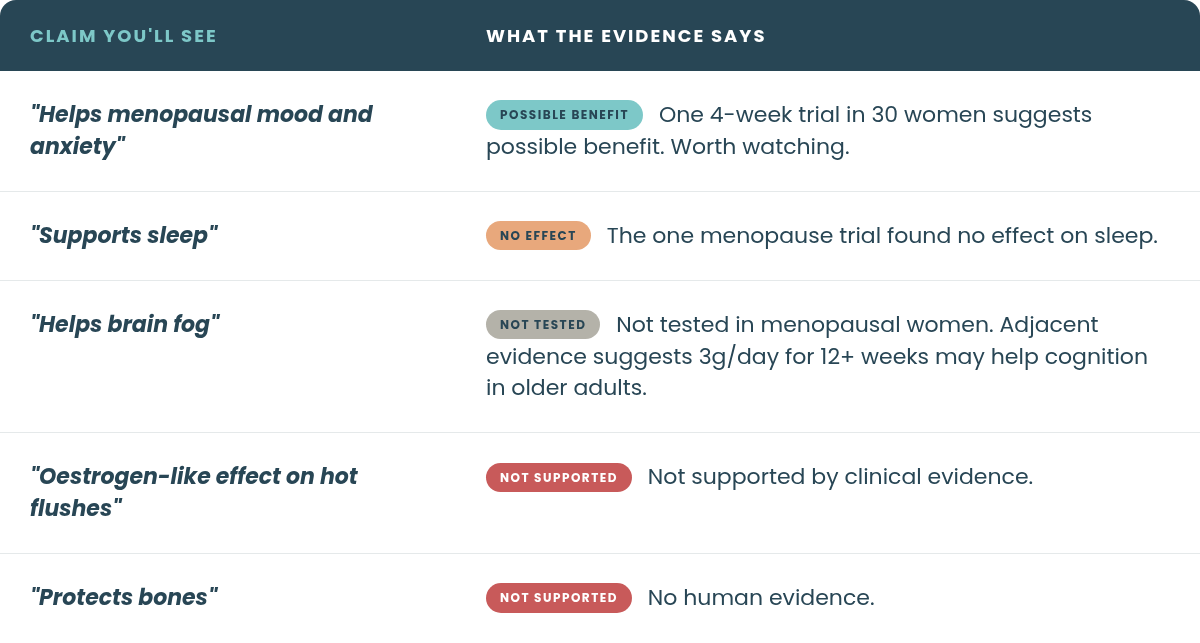
One small randomised trial in menopausal women. Nagano 2010: 30 women, average age 41, given 2g/day of lion's mane powder in cookies or placebo for 4 weeks [2]. Results:
- Depression scores improved (CES-D)
- Irritation, palpitation and concentration improved (ICI)
- No improvement in sleep (PSQI)
- One participant reported irregular bleeding
Beyond that, there's no menopause-specific trial. A 2025 systematic review of 26 human studies confirms this [3]. A larger 2024 review of 34 studies across all ages concluded lion's mane shows benefits only at doses of at least 3g/day for 12 weeks or longer, mostly in middle-aged and older adults [4].
Common claims vs. evidence
Practical points if you're considering it
- Dose matters. Studies showing benefit used 2 to 3g/day. Many gummies and low-dose capsules contain far less.
- Time matters. Cognitive effects, where seen, took 12 weeks or more.
- Quality varies hugely. Supplements aren't regulated like medicines. Look for products stating the amount of dried mushroom equivalent, not just "proprietary blend."
- Talk to your doctor or pharmacist before starting any supplement, especially if you take prescription medicines, have a medical condition, are pregnant or breastfeeding, or have planned surgery.
The bottom line
Lion's mane has one small, promising trial in women around menopause, and a lot of marketing that outruns it. The mood signal is hopeful, but we need more trials. If you want to try it, use a dose and duration that match what's been studied, and judge for yourself after 12 weeks.
References
- Spangenberg ET, et al. Unveiling the role of erinacines in the neuroprotective effects of Hericium erinaceus: a systematic review in preclinical models. Front Pharmacol. 2025;16:1582081. PMID: 40626304. https://pubmed.ncbi.nlm.nih.gov/40626304/
- Nagano M, et al. Reduction of depression and anxiety by 4 weeks Hericium erinaceus intake. Biomed Res. 2010;31(4):231-7. PMID: 20834180. https://pubmed.ncbi.nlm.nih.gov/20834180/
- Menon A, et al. Benefits, side effects, and uses of Hericium erinaceus as a supplement: a systematic review. Front Nutr. 2025;12:1641246. PMID: 40959699. https://pubmed.ncbi.nlm.nih.gov/40959699/
- Cha S, Bell L, Shukitt-Hale B, Williams CM. A review of the effects of mushrooms on mood and neurocognitive health across the lifespan. Neurosci Biobehav Rev. 2024;158:105548. PMID: 38246232. https://pubmed.ncbi.nlm.nih.gov/38246232/
- Mori K, et al. Improving effects of the mushroom Yamabushitake (Hericium erinaceus) on mild cognitive impairment: a double-blind placebo-controlled clinical trial. Phytother Res. 2009;23(3):367-72. PMID: 18844328. https://pubmed.ncbi.nlm.nih.gov/18844328/