Why you're being sold collagen right now
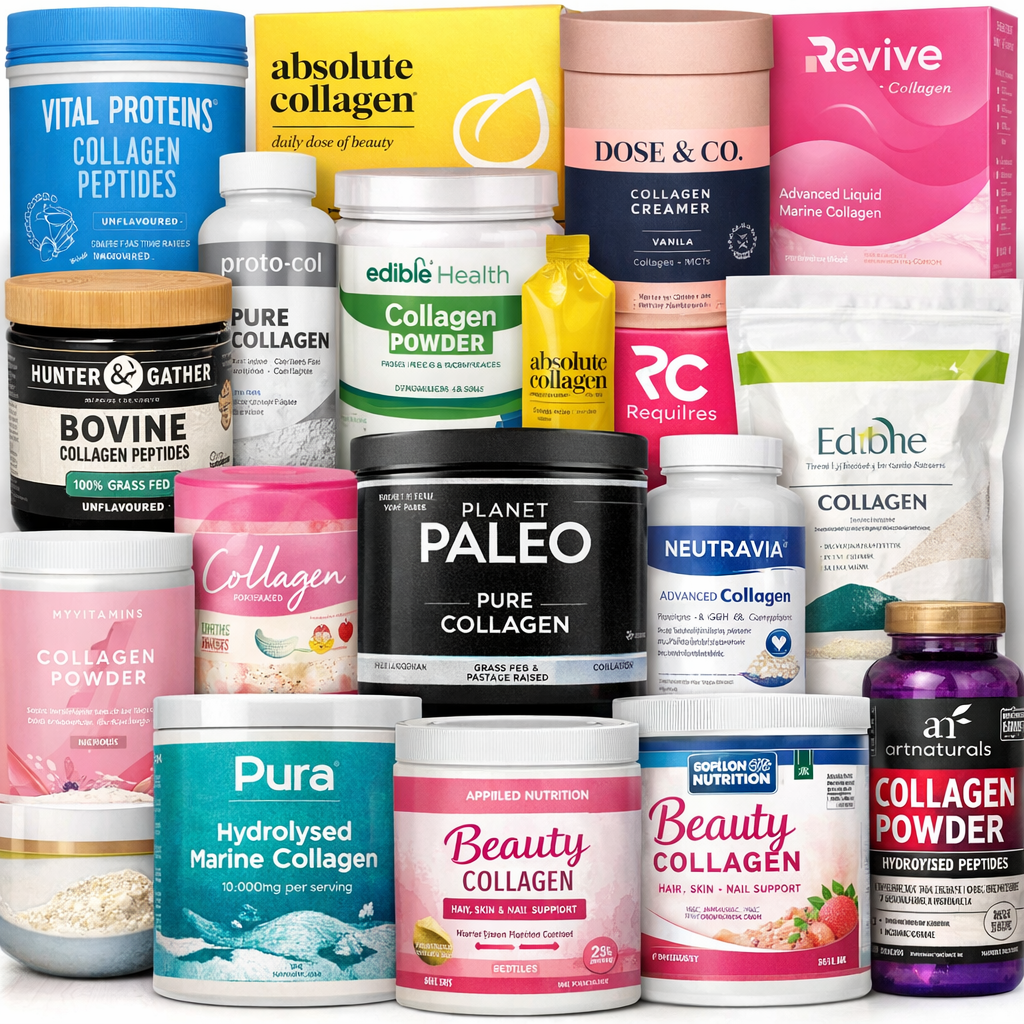
If you're in perimenopause or menopause, you have probably been served an ad for a collagen supplement. The marketing is consistent: glowing skin, stronger bones, healthier joints. And it's targeted at you specifically, because oestrogen decline is real, measurable, and does accelerate collagen loss.
That part is true. The question is whether swallowing hydrolysed collagen does anything useful about it.
What actually happens to collagen in menopause?
Collagen is the most abundant protein in your body. It gives skin its structure, keeps bones tough rather than brittle, and cushions your joints. Oestrogen is central to collagen synthesis, and when oestrogen drops in perimenopause, collagen production declines noticeably.
Studies estimate skin loses around 30% of its collagen in the first five years after menopause [1].
This is legitimate biology. The supplement industry didn't invent the problem. What it invented is the implication that taking hydrolysed collagen orally straightforwardly fixes it.
What are collagen supplements, exactly?
Collagen supplements are made from hydrolysed collagen, meaning large collagen proteins broken down into smaller peptides, usually from bovine (cow), marine (fish), porcine (pig), or chicken sources. The theory is that when you swallow these peptides, they are absorbed into the bloodstream, reach the skin and other tissues, and signal fibroblasts, the cells that make collagen, to produce more [2].
That mechanism is biologically plausible in lab studies. Whether it plays out meaningfully in real women is what the clinical trials are for.
What the evidence shows for skin
The headline from the most recent meta-analysis
The most important study for your decision-making is a 2025 systematic review and meta-analysis that pooled 23 RCTs with 1,474 participants [3]. The headline finding from pooling all studies: collagen supplements improved skin hydration, elasticity, and wrinkles.
But read the subgroup analysis, because that's where it gets honest.
- When the researchers separated studies by funding source, studies that did not receive pharmaceutical company funding showed no effect on skin hydration, elasticity, or wrinkles [3].
- Studies funded by pharmaceutical companies did show significant effects. High-quality studies showed no significant effect across any category, while low-quality studies showed improvement in elasticity only [3].
-
The authors' conclusion is worth stating directly: there is currently no clinical evidence to support the use of collagen supplements to prevent or treat skin ageing [3].
That is a strong conclusion. It comes from the largest, most rigorous analysis to date, published in 2025.
What did the earlier meta-analyses find?
Earlier meta-analyses were more optimistic, and they are the ones brands tend to cite.
- A 2023 meta-analysis of 26 RCTs involving 1,721 participants found that hydrolysed collagen supplementation significantly improved skin hydration and elasticity compared to placebo [4]. It also identified several biases in the included trials.
- A 2021 meta-analysis of 19 RCTs in 1,125 participants, 95% of them women, concluded that ingestion of hydrolysed collagen for 90 days is effective in reducing wrinkles and improving skin elasticity and hydration [5].
So older meta-analyses point one way; the most recent and most rigorous one points the other. The difference is that the 2025 analysis specifically examined funding bias and study quality, which earlier analyses did not do. When you control for those factors, the effect disappears in high-quality, independently funded research [3].
The critical point for perimenopausal women specifically
Most RCTs in this area include women broadly aged 20 to 70, not perimenopausal or postmenopausal women as a defined group. There are exceptions: one RCT studied postmenopausal women aged 60 to 93 and reported improvements in dermal collagen content and skin thickness after 24 weeks [6]. But studies designed specifically around menopausal status, with menopausal status as a defined variable, are sparse. The studies exist; the menopause-specific evidence does not, at the standard you would need to say "this works in women like you."
Bottom line on skin: The evidence that collagen supplements improve skin in perimenopausal women is not strong. The more rigorous and independent the study, the smaller the effect. The marketing is running well ahead of the science.
What the evidence shows for bones
This is where it gets more interesting
The bone evidence is more coherent than the skin evidence, and the studies are more likely to include postmenopausal women specifically, because bone loss is a defined clinical concern in this population.
- A 2025 meta-analysis of 17 RCTs found that supplementing with specific bioactive collagen peptides appears to be a useful way to compensate for bone mineral density (BMD) declines in postmenopausal women, with positive changes in bone markers indicating less bone deterioration and more bone growth [7]. There is also evidence that collagen peptides may be effective in combination with calcium and vitamin D, shifting the balance from bone resorption towards bone formation [7].
- The strongest single trial in this area gave 5g of specific collagen peptides daily for 12 months to 131 postmenopausal women [8]. It found significant increases in spine and femoral neck BMD, both clinically important sites for fracture risk [7, 8].
- A Greek RCT in 51 postmenopausal women with osteopenia added collagen peptides to a standard calcium and vitamin D regimen and compared outcomes to calcium and vitamin D alone [9]. The group receiving collagen showed a significant increase in trabecular bone mineral content and volumetric BMD at the tibia after 12 months [9].
A longer-term follow-up study extended observations to four years, finding statistically significant improvements in spine BMD from baseline to year two and year four in women receiving collagen peptides [10].
What this actually means
The bone data is more encouraging than the skin data, but important caveats apply.
- The strongest results involve specific bioactive collagen peptides, a particular peptide formulation studied predominantly in Germany, not "collagen" as a generic category. You cannot assume a marine collagen powder from a high-street brand will replicate these results.
- Collagen for bone health has consistently been studied alongside calcium and vitamin D, not as a standalone intervention. Whether collagen alone does much for bone is less clear [7].
- None of this supersedes the established interventions for postmenopausal bone health. NICE and the British Menopause Society are clear that HRT, calcium, vitamin D, and weight-bearing exercise are the primary tools. Collagen is not in those guidelines.
Bottom line on bones: There is genuinely promising RCT evidence that specific collagen peptides, added to calcium and vitamin D, may help preserve bone density in postmenopausal women. It is not proven enough to be a clinical recommendation, and it depends heavily on the specific peptide formulation tested, not collagen as a category.
What the evidence shows for joints
RCTs in general populations suggest collagen supplementation can reduce joint pain and improve mobility. However, trials conducted exclusively in perimenopausal or menopausal women on joint outcomes are sparse. A 2025 systematic review concluded that studies on joint health reported beneficial outcomes including pain reduction, improved clinical parameters, and increased physical mobility [5]. The joint evidence is more consistent than the bone evidence, but it is not specific to your life stage.
Bottom line on joints: Possible benefit, but the evidence in perimenopausal and menopausal women specifically is thin.
What the marketing doesn't tell you
The funding problem is significant. The majority of positive skin trials are funded by supplement manufacturers. Studies not funded by pharmaceutical companies showed no significant effect on skin hydration, elasticity, or wrinkles [3]. This is not subtle. It is a finding that should change how you read any collagen brand citing clinical studies.
"Clinically proven" can mean almost anything. Brands routinely cite the same small, company-funded trials. A study with 60 participants funded by the company selling the product is not the same as independent evidence.
Dose and formulation matter enormously. Most trials use specific hydrolysed collagen peptides at doses of 5 to 10g per day. Products on the market vary widely in source, formulation, and dose [2]. You cannot assume what is in your collagen sachet matches what was tested.
Collagen is not a substitute for oestrogen. Oestrogen is what regulated collagen synthesis in the first place. If you are eligible for HRT and your main concern is the systemic effects of oestrogen deficiency, including collagen decline, that is a different conversation from buying a supplement.
The bottom line
The biology is real: menopause accelerates collagen loss [1]. The supplement industry has responded with a large, well-marketed product category. The clinical evidence for skin benefits is weaker than the marketing suggests, and the most rigorous independent analysis published to date found no evidence of benefit for skin in high-quality or independently funded studies [3]. The evidence for bone health in postmenopausal women is more interesting, particularly when specific peptides are added to calcium and vitamin D, but it is nowhere near strong enough to be in clinical guidelines [7, 8, 9]. The joint evidence is promising but not specific to this population [5].
Bottom line: it can't hurt, but the evidence is still a bit shakey for some of the prices these supplements demand.
References
- Calleja-Agius J, Brincat M. The effect of menopause on the skin and other connective tissues. Gynecol Endocrinol 2012;28:273-277. PMID: 22136214.
- Naafs MA et al. Collagen supplementation and regenerative health: advances in biomarker detection and smart material integration. PMC 2025. PMID: not assigned at time of writing.
- Myung SK et al. Effects of collagen supplements on skin aging: a systematic review and meta-analysis of randomized controlled trials. Am J Med 2025. PMID: 40324552.
- Pu SY et al. Effects of oral collagen for skin anti-aging: a systematic review and meta-analysis. Nutrients 2023;15:2080. PMID: 37432180.
- Avila Rodriguez MI et al. Effects of collagen supplementation on aging skin: systematic review and meta-analysis. Int J Dermatol 2021;60:1449-1461. PMID: 33742704.
- Reilly DM et al. A clinical trial shows improvement in skin collagen, hydration, elasticity, wrinkles, scalp, and hair condition following 12-week oral intake of a supplement containing hydrolysed collagen. Dermatol Res Pract 2024;2024:8752787. PMID: 39039432.
- Naafs MA et al. Efficacy of collagen peptide supplementation on bone and muscle health: a meta-analysis. Front Nutr 2025. PMID: 41049371.
- König D et al. Specific collagen peptides improve bone mineral density and bone markers in postmenopausal women: a randomized controlled study. Nutrients 2018;10:97. PMID: 29337906.
- Lampropoulou-Adamidou K et al. Effect of calcium and vitamin D supplementation with and without collagen peptides on volumetric and areal bone mineral density, bone geometry and bone turnover in postmenopausal women with osteopenia. J Clin Densitom 2022;25:357-372. PMID: 35933897.
- Zdzieblik D et al. Specific bioactive collagen peptides in osteopenia and osteoporosis: long-term observation in postmenopausal women. J Bone Metab 2021;28:207-213. PMID: 34504688.
A note on this review
Prove It Health only uses systematic reviews, meta-analyses, and RCTs as evidence. We do not include observational studies, case reports, or expert opinion. Where trials were not conducted specifically in perimenopausal or menopausal women, we say so.