
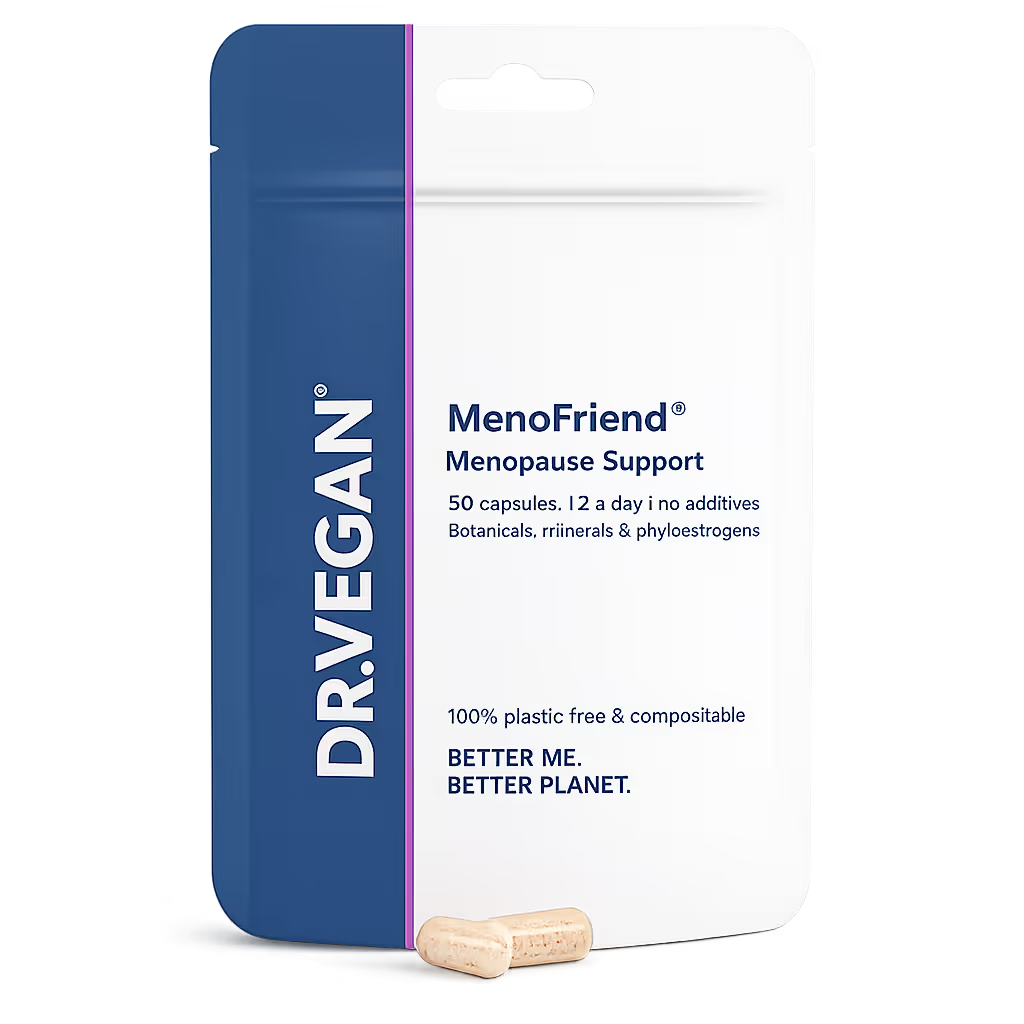
DR VEGAN MenoFriend
Can they prove what they say?
Not really. It contains some basics like Vitamin D, B6 and B12, but most multivitamins do. But they boldy claim "hormone regulation" and none of the ingredients have quality evidence backing that up.




What's in it
MenoFriend is a food supplement containing 19 plant based ingredients. The formula includes botanicals such as wild yam, red clover, sage, hops, dong quai, maca, dandelion root, mung bean and kelp, alongside B vitamins (B2, B3, B5, B6, B12), vitamin D, vitamin K2, calcium, magnesium and selenium. The exact doses of the botanical ingredients are not publicly disclosed on the brand website or retailer listings.
What MenoFriend claims
Dr Vegan promotes MenoFriend as an "advanced formula with proven nutrients supporting hormonal balance and regulation."
The brand highlights specific botanicals with particular claims.
- Wild yam is "acclaimed for helping maintain calm and comfort."
- Dong Quai "has been extensively studied for helping regulate hormones."
- Red Clover is "widely studied for its role in supporting cardiovascular health."
The product is also said to provide "improved energy, concentration, focus and memory" and to "support women's intimate health, menopausal comfort, and libido."
What the evidence actually shows
Red clover
Dr Vegan states that red clover is "widely studied for its role in supporting cardiovascular health," but does not make an explicit claim about hot flushes on the main product page, though the brand does link red clover to menopausal symptom relief elsewhere in its materials. The evidence shows that red clover does have some support for hot flush reduction. A review of eight randomised controlled trials found it reduced hot flush frequency by around 1.7 fewer flushes per day compared to placebo, with the clearest benefit at doses of 80mg or more per day [1].
The dose in MenoFriend is not publicly disclosed, so women cannot assess whether they are receiving a dose consistent with the trial evidence.
Sage
The brand does not make specific symptom claims for sage on the main product pages, though retailer descriptions state sage is "traditionally associated with temperature regulation and mental clarity." There is reasonable evidence from randomised controlled trials for reductions in hot flush frequency and severity at 100 to 300mg per day [2, 3].
Again, the dose in MenoFriend is undisclosed, making it impossible to know whether this ingredient is present at a meaningful level.
Hops
Hops receives limited direct claims from the brand. Dr Vegan describes hops as "a traditional botanical included to support relaxation and overall wellbeing."
Hops contains a phytoestrogen called 8 prenylnaringenin. A randomised controlled trial of 67 menopausal women found standardised hops extract was significantly better than placebo for hot flushes at 6 weeks, though the effect was not sustained to 12 weeks [4]. A separate randomised controlled trial in 120 women found significant reductions in hot flushes over 12 weeks [5].
The evidence is promising but still limited in scale, and once more, the dose is not disclosed.
Dong quai
Dr Vegan claims dong quai "has been extensively studied for helping regulate hormones." This is misleading.
Despite centuries of use in traditional Chinese medicine, the best quality randomised controlled trial found dong quai used alone was no more effective than placebo for menopausal symptoms, and produced no measurable oestrogen-like effects [6]. Most evidence comes from multi herb combinations, not dong quai as a standalone ingredient. The claim that it has been "extensively studied" for hormone regulation is not supported by the evidence when used in isolation.
Wild yam
Wild yam is described as "acclaimed for helping maintain calm and comfort," with retailer listings stating it is "traditionally used for hot flushes, sweats and restlessness."
There is no meaningful randomised controlled trial evidence for wild yam in menopausal symptom relief. The claim rests on traditional use rather than clinical demonstration.
Maca, dandelion root, mung bean and kelp
The brand states maca is "a popular botanical studied for supporting physical and mental wellbeing, stamina, and feelings of vitality." Dandelion root, mung bean and kelp receive minimal or no efficacy claims on the brand website. There is no meaningful randomised controlled trial evidence for any of these ingredients in menopausal symptom relief.
Vitamin B6
The brand highlights "proven nutrients supporting hormonal balance and regulation."
Vitamin B6 holds an EU approved claim for regulation of hormonal activity [7], which the brand is entitled to make. However, randomised controlled trials have not demonstrated benefit for mood or cognition in non deficient women [8, 9]. The regulatory claim does not equate to clinical efficacy for menopausal symptoms.
Vitamin D
Vitamin D is included alongside claims for energy and general wellbeing. Vitamin D has solid evidence for supporting bone health in postmenopausal women, but the Women's Health Initiative, a large randomised controlled trial in over 34,000 women, found it did not improve hot flushes, mood or sleep [10]. The brand does not overstate what vitamin D can do, but women may reasonably infer broader benefits than the evidence supports.
Vitamin K2, calcium and magnesium
The brand states the formula "includes key nutrients providing daily support for maintenance of bones and muscles."
This is accurate. Vitamin K2 has good evidence for bone health in postmenopausal women, specifically supporting bone mineral density [11]. Calcium contributes to normal bone function, and the evidence is well established in this population. Magnesium and selenium may address deficiencies common in midlife but lack perimenopause specific randomised controlled trial evidence for symptom relief. The bone health claims are fair and supported.
References
[1] Kanadys W et al. Nutrients. 2021;13(4):1258. https://pubmed.ncbi.nlm.nih.gov/33920485/
[2] Moradi M et al. Int J Community Based Nurs Midwifery. 2023;11(3):169–78. https://pubmed.ncbi.nlm.nih.gov/37363758/
[3] Bommer S, Klein P, Suter A. Adv Therapy. 2011;28:490–500. https://pubmed.ncbi.nlm.nih.gov/21630133/
[4] Heyerick A et al. Maturitas. 2006;54(2):164–75. https://pubmed.ncbi.nlm.nih.gov/16321485/
[5] Mohammad-Alizadeh-Charandabi S et al. Complement Ther Clin Pract. 2015;21(2):105–9. https://pubmed.ncbi.nlm.nih.gov/25982391/
[6] Hirata JD et al. Fertil Steril. 1997;68(6):981–6. https://pubmed.ncbi.nlm.nih.gov/9418683/
[7] EFSA. EFSA Journal. 2010;8(10):1759. https://efsa.onlinelibrary.wiley.com/doi/10.2903/j.efsa.2010.1759
[8] Malouf R, Grimley Evans J. Cochrane Database Syst Rev. 2003. https://pubmed.ncbi.nlm.nih.gov/14584010/
[9] Balk EM et al. Arch Intern Med. 2007;167(1):21–30. https://pubmed.ncbi.nlm.nih.gov/17210874/
[10] LeBlanc ES et al. Maturitas. 2015;81(3):377–83. https://pubmed.ncbi.nlm.nih.gov/26044075/
[11] Knapen MH et al. Osteoporos Int. 2013;24(9):2499–507. https://pubmed.ncbi.nlm.nih.gov/23525894/
Wild Yam Extract
Organic dandelion root powder
Mung bean powder
Sage extract
Dong quai root powder
Phytoestrogens
Hops extract
Maca Root Extract
Selenium
Calcium
Vitamin K2
Kelp extract
Vitamin B5
Vitamin B12
Vitamin B2
Vitamin D

Related Articles
You might be intrested in reading...