
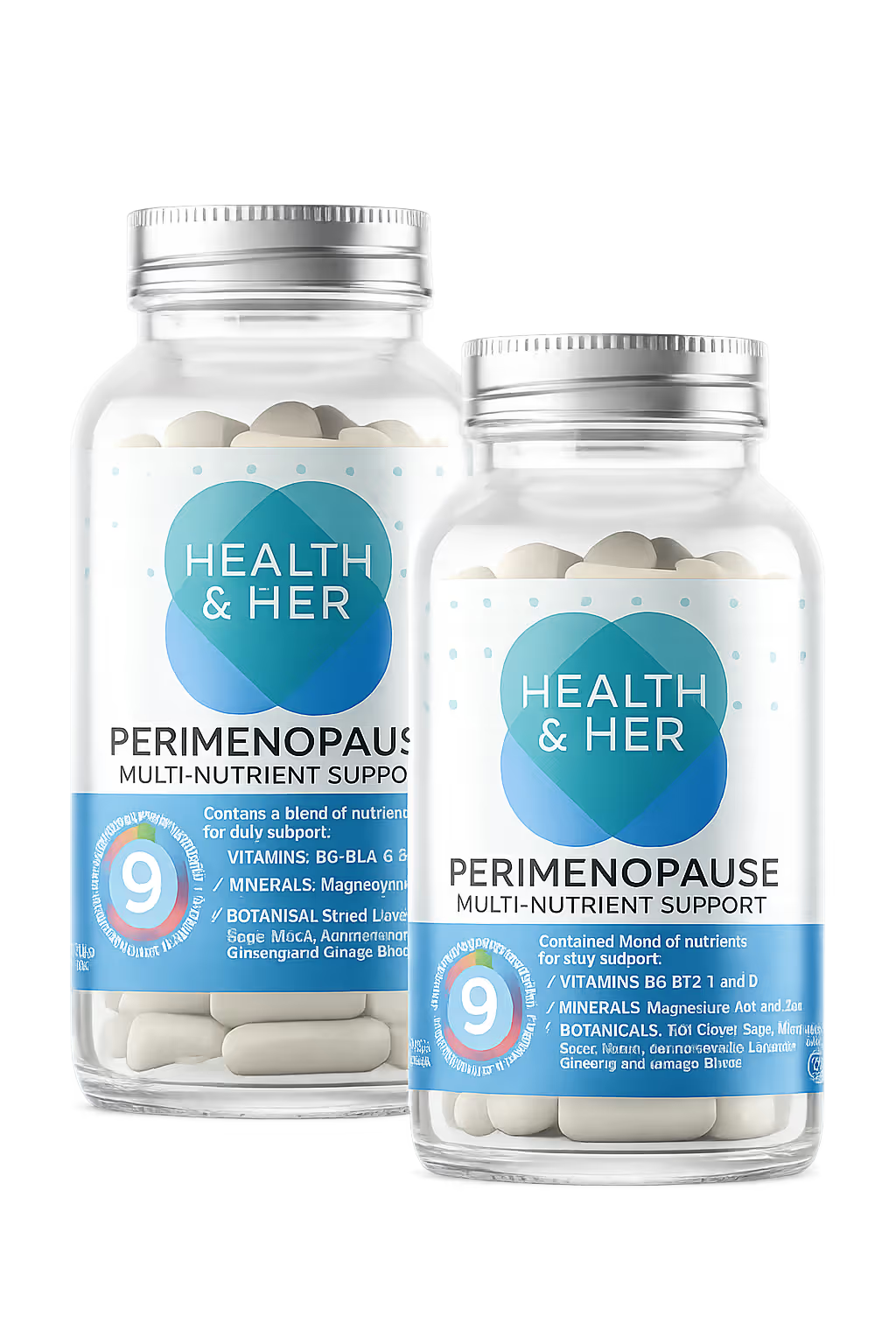
Health & Her Perimenopause Multinutrient Support
Can they prove what they say?
Yes, with a catch. It contains some basics like Vitamin D, B6 and B12, but most multivitamins do. The menopause link relies on the red clover, sage and ashwagandha ingredients, but the they've been tested in only a tiny number of trials showing modest improvements in symptoms. And the dosing is a bit all over the place in those trials.



What's in it
Health and Her Perimenopause Multi Nutrient is a daily food supplement containing four vitamins (B6, B12, C, and D3), three minerals (magnesium, iron, and zinc), and eight botanicals: red clover, wild yam, sage, maca, ashwagandha, Siberian ginseng, ginkgo biloba, and lavender. It is designed to be taken as two capsules daily.
What the guidelines say
For complementary therapies, NICE [1] says the safety, quality and purity of unregulated preparations may be unknown and that there is only "some evidence" for isoflavones or black cohosh specifically. NICE does not mention or recommend multi-ingredient supplements like this product.
NAMS (2023) explicitly lists supplements and herbal remedies as "not recommended" [2].
The BMS/RCOG (2022) takes a similar position, recommending a holistic and individualised approach but noting that few complementary options have proven evidence [5][6].
The IMS (2024) calls for proper regulation of complementary therapy products and notes they often lack efficacy [7].
What the evidence shows for each key ingredient
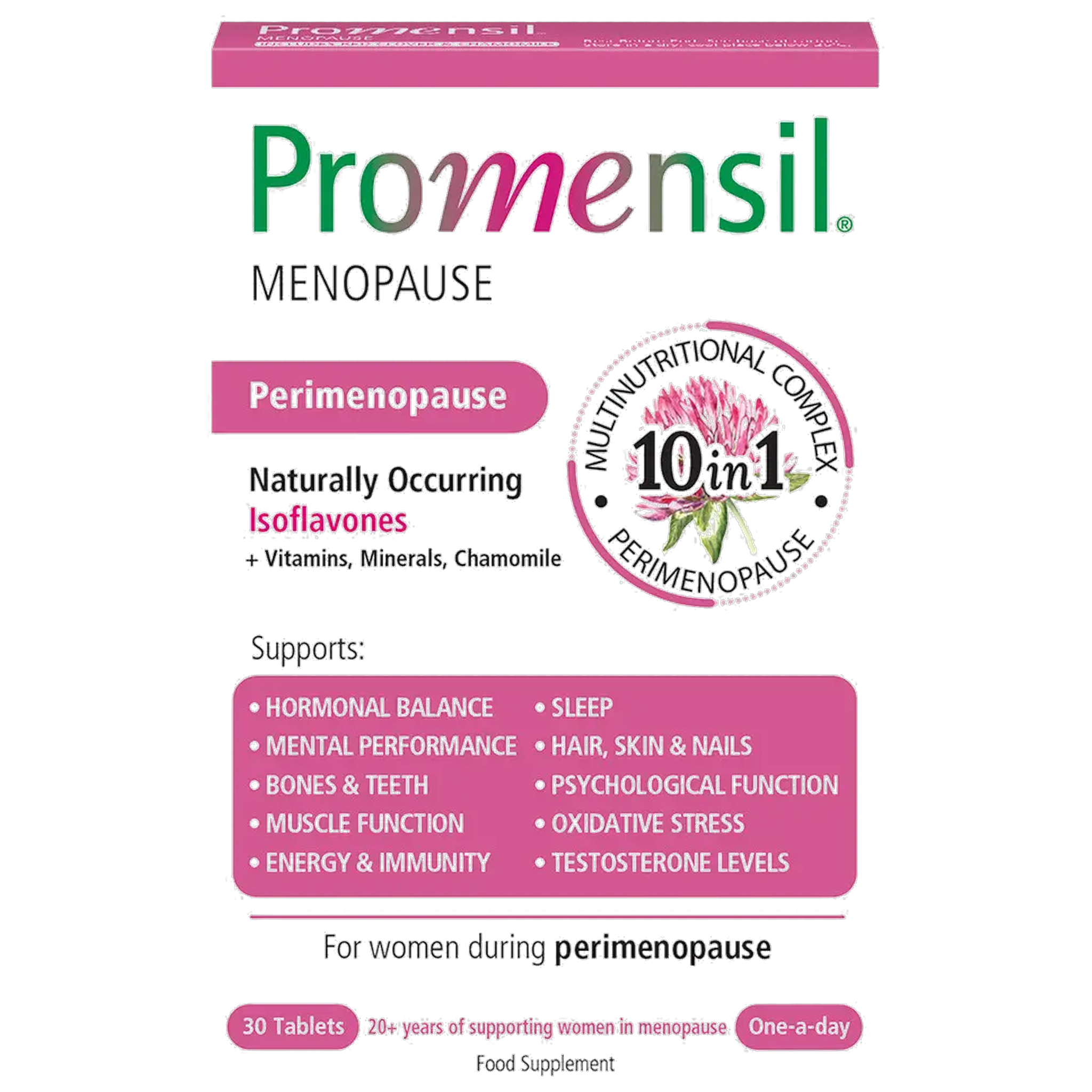
- Red Clover: The strongest evidence in this product. Meta-analyses suggest a modest reduction in hot flush frequency, but mainly at higher isoflavone doses (80 mg/day or more) than what this product appears to contain [3][8]. Results are inconsistent across individual trials, and heterogeneity is high.
- Sage: Promising but preliminary. Small RCTs suggest itmay reduce hot flushes and night sweats [4][9][10]. Studies have methodological weaknesses. N
- Maca: Limited evidence from 4 small RCTs showing favourable effects on menopausal symptoms, but study quality is low and sample sizes are small [11][12].
- Ashwagandha: One small RCT in perimenopausal women showed improvements in menopausal symptoms and hormonal markers [13]. Promising but very early stage.
- Wild Yam: The only placebo-controlled RCT found no benefit for menopausal symptoms [15]. The body cannot convert its active compound (diosgenin) into hormones. Not supported by clinical evidence.
- Ginkgo Biloba, Siberian Ginseng, Lavender: No systematic reviews or robust RCTs specifically for perimenopause or menopause symptoms.
Do any marketing claims go beyond the evidence?
- The overall framing of the product as "designed to support mind and body well-being during perimenopause in 9 ways" strongly implies perimenopause-specific benefits. You could reasonably expect this product to help with perimenopause symptoms based on the branding, product name and context, even though the individual ingredient claims are general.
- The claim of "natural phytoestrogens" from Red Clover is factually accurate, but the dose of isoflavones in this product may be below what was used in positive clinical trials.
- The reference to "extensive research with thousands of women" could be read as implying clinical testing of theproduct. In fact, it appears to refer to market research on symptom experience, not clinical trials of the product itself.
References
[1]National Institute for Health and Care Excellence (NICE). Menopause:identification and management (NG23). Updated November 2024. Available at:https://www.nice.org.uk/guidance/ng23. No PMID (clinical guideline).
[2]The North American Menopause Society. The 2023 nonhormone therapy positionstatement. Menopause 2023;30(6):573-590. PMID: 37252752.https://pubmed.ncbi.nlm.nih.gov/37252752/
[3]Kanadys W et al. Evaluation of clinical meaningfulness of red clover extract torelieve hot flushes and menopausal symptoms in peri- and post-menopausal women:a systematic review and meta-analysis of RCTs. Nutrients 2021;13(4):1258. PMID:33920160. https://pubmed.ncbi.nlm.nih.gov/33920160/
[4]Abdnezhad R et al. The effect of Salvia officinalis on hot flashes inpostmenopausal women: a systematic review and meta-analysis. J Obstet Gynaecol2023;43(1):2221585. PMID: 37489230. https://pubmed.ncbi.nlm.nih.gov/37489230/
[5]Hamoda H et al. Joint position statement by the British Menopause Society,Royal College of Obstetricians and Gynaecologists and Society for Endocrinologyon best practice recommendations for the care of women experiencing themenopause. Post Reproductive Health 2022;28(4):209-227. Available at:https://journals.sagepub.com/doi/full/10.1177/20533691221104879
[6]British Menopause Society. Non-hormonal-based treatments for menopausalsymptoms: consensus statement. Updated November 2025. Available at:https://thebms.org.uk/publications/consensus-statements/non-hormonal-based-treatments-menopausal-symptoms/.No PMID (clinical guideline).
[7]International Menopause Society. Menopause and MHT in 2024: addressing the keycontroversies. Climacteric 2024. Available at:https://www.tandfonline.com/doi/full/10.1080/13697137.2024.2394950
[8]Myers SP, Vigar V. Effects of a standardised extract of Trifolium pratense(Promensil) at a dosage of 80 mg in the treatment of menopausal hot flushes: asystematic review and meta-analysis. Phytomedicine 2017;24:141-147. PMID:28160855. https://pubmed.ncbi.nlm.nih.gov/28160855/
[9]Bommer S, Klein P, Suter A. First time proof of sage's tolerability andefficacy in menopausal women with hot flushes. Advances in Therapy2011;28(6):490-500. PMID: 21630133. https://pubmed.ncbi.nlm.nih.gov/21630133/
[10]Kiani Rad S et al. The effect of salvia officinalis tablet on hot flashes,night sweating, and estradiol hormone in postmenopausal women. Int J Med ResHealth Sci 2016;5(8):257-263.
[11]Lee MS et al. Maca (Lepidium meyenii) for treatment of menopausal symptoms: asystematic review. Maturitas 2011;70(3):227-233. PMID: 21840656.https://pubmed.ncbi.nlm.nih.gov/21840656/
[12]Shin BC et al. Maca (L. meyenii) for improving sexual function: a systematicreview. BMC Complement Altern Med 2010;10:44. PMID: 20691074.https://pubmed.ncbi.nlm.nih.gov/20691074/
[13]Gopal S et al. Prospective, randomized, double-blind, placebo-controlled studyon safety and efficacy of ashwagandha root extract (Withania somnifera) onmenopause symptoms. J Obstet Gynaecol Res 2021. Available at:https://www.researchgate.net/publication/390684252
[14]Smith SJ et al. Exploring the efficacy and safety of a novel standardizedashwagandha root extract in adults experiencing high stress and fatigue in arandomized, double-blind, placebo-controlled trial. J Psychopharmacol2023;37(12). Available at: https://journals.sagepub.com/doi/10.1177/02698811231200023
[15]Komesaroff PA et al. Effects of wild yam extract on menopausal symptoms, lipidsand sex hormones in healthy menopausal women. Climacteric 2001;4(2):144-150.PMID: 11428178. https://pubmed.ncbi.nlm.nih.gov/11428178/
Vitamin D
Vitamin B6
Vitamin B12
Vitamin E
Magnesium
Vitamin C
Iron
Sage extract
Wild Yam Extract
Ginkgo biloba leaf extract
Lavender Grass Extract
Siberian Ginseng Root Extract
Ashwagandha Root Extract
Maca Root Extract

Related Articles
You might be intrested in reading...