
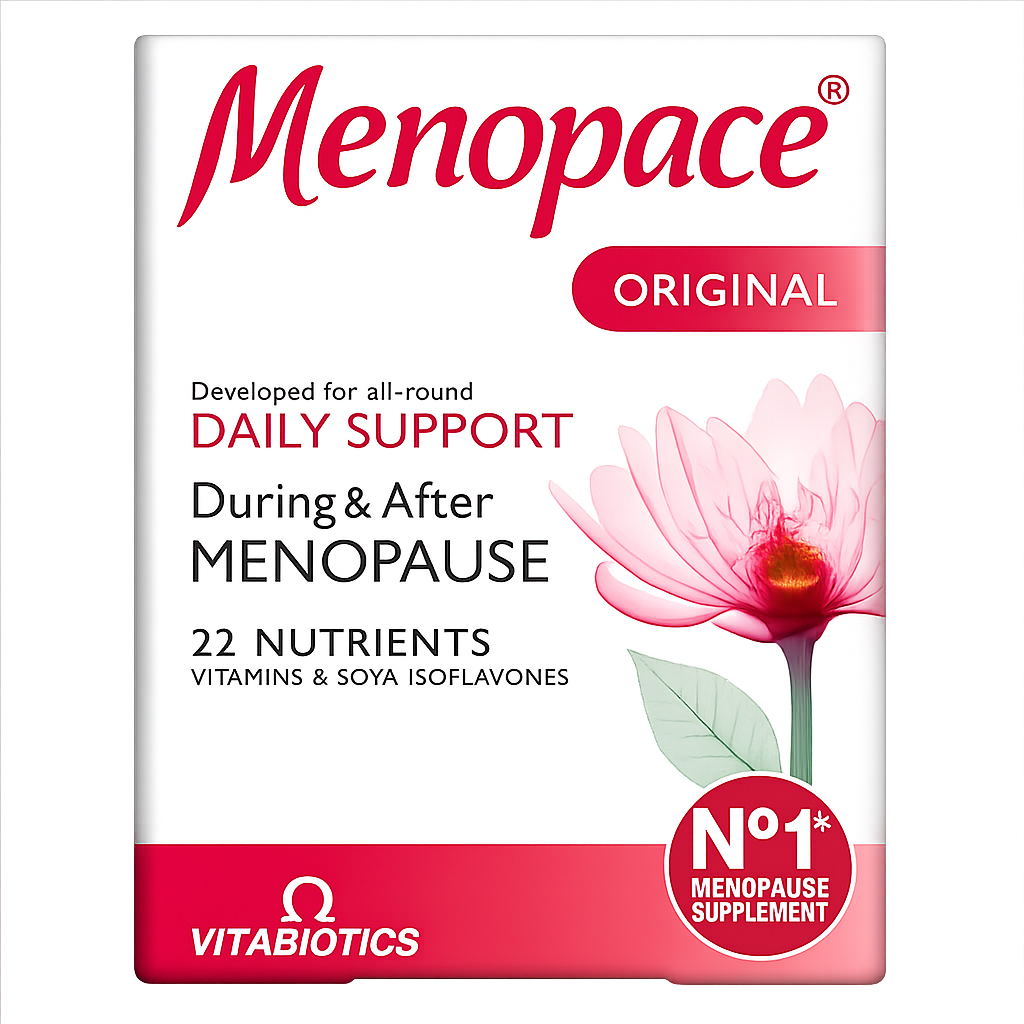
Vitabiotics Menopace Original
Can they prove what they say?
Yes, with a catch. It contains some basics like Vitamin D, B6 and magnesium, but most multivitamins do. The menopause link relies on the soy isoflavone ingredient, but the dose is half what's been tested in only a tiny number of trials showing modest improvements in symptoms.



What it is: A daily multivitamin tablet with 22 nutrients including B vitamins, vitamin D, zinc, magnesium and a small dose of soy isoflavones (20mg), marketed for perimenopause and menopause.
What the evidence says for soy isoflavones:
This is the only ingredient in Menopace Original that has been studied specifically in the context of menopause symptoms. Findings are mixed:
- A 2012 meta-analysis of 17 RCTs found that soy isoflavones (median dose 54mg) modestly reduced hot flush frequency and severity [5].
- A 2025 meta-analysis focused specifically on perimenopausal women (12 RCTs) found a small overall benefit for total menopausal symptoms, including mood-related symptoms — but found no significant effect on hot flushes, night sweats, or vasomotor symptoms [7].
- A 2024 meta-analysis found no significant effect on menopausal symptoms at all [8].
- Crucially, Menopace Original contains only 20mg of soy isoflavones — roughly half the dose used in studies that showed any benefit (typically 40–80mg/day). Whether this dose has any clinical effect on menopause symptoms is not established.
What the evidence says for other key ingredients:
- Vitamin D (10µg): Consistent with UK population guidance. Evidence from RCTs supports its role in bone health, particularly when combined with calcium — which Menopace Original does not contain [9]. No menopause-specific symptom evidence.
- Vitamin B6, B12, magnesium, zinc, iron, biotin, folate, pantothenic acid: No RCTs or meta-analyses found specifically testing these ingredients for menopause symptom relief at the doses in Menopace Original. The claims made about them (e.g. "B6 contributes to regulation of hormonal activity") are EU/UK authorised regulatory claims about normal physiology — not evidence that the supplement reduces menopause symptoms.
What the guidelines say:
- NICE NG23 (updated November 2024) [1] recommends HRT as the primary treatment for vasomotor symptoms. On complementary therapies it states that while there is "some evidence" that isoflavones may help vasomotor symptoms, the safety of multiple preparations is uncertain. No mention of multivitamin supplements like Menopace.
- BMS Consensus Statement on Non-Hormonal Treatments (September 2024, updated November 2025) [2] lists isoflavones among "self-help options" that have been used, but they are not placed in the same category as prescription treatments with robust RCT evidence.
References
[1] National Institute for Health and Care Excellence. Menopause: identification and management. NICE guideline NG23. November 2015, updated November 2024. Available at: https://www.nice.org.uk/guidance/ng23. No PMID (clinical guideline).
[2] British Menopause Society. Non-hormonal-based treatments for menopausal symptoms. BMS Consensus Statement. September 2024 (updated November 2025). Available at: https://thebms.org.uk/publications/consensus-statements/. No PMID (clinical guideline).
[3] Shufelt C et al. The 2023 nonhormone therapy position statement of The North American Menopause Society. Menopause 2023;30(6):573–590. PMID: 37252752. https://pubmed.ncbi.nlm.nih.gov/37252752/
[4] Kirby RS et al. Menopace nutrient therapy: an alternative approach to pharmaceutical treatments for menopause. Int J Fertil Womens Med 2006;51(3):125–9. PMID: 17039856. https://pubmed.ncbi.nlm.nih.gov/17039856/
[5] Taku K et al. Extracted or synthesized soybean isoflavones reduce menopausal hot flash frequency and severity: systematic review and meta-analysis of randomized controlled trials. Menopause 2012;19(7):776–90. PMID: 22433977. https://doi.org/10.1097/gme.0b013e3182410159
[6] Chen M-N et al. Efficacy of phytoestrogens for menopausal symptoms: a meta-analysis and systematic review. Climacteric 2015;18(2):260–9. PMID: 25263312. https://doi.org/10.3109/13697137.2014.966241
[7] Luan H et al. Effects of soy isoflavones on menopausal symptoms in perimenopausal women: a systematic review and meta-analysis. PeerJ 2025;13:e19715. PMID: 40718787. https://doi.org/10.7717/peerj.19715
[8] Gençtürk N et al. The effect of soy isoflavones given to women in the climacteric period on menopausal symptoms and quality of life: systematic review and meta-analysis of randomized controlled trials. Explore (NY) 2024;20(6):103012. PMID: 38825560. https://doi.org/10.1016/j.explore.2024.05.010
[9] Reis AR et al. Supplementation of vitamin D isolated or calcium-associated with bone remodeling and fracture risk in postmenopausal women without osteoporosis: a systematic review of randomized clinical trials. Nutrition 2023;116:112151. PMID: 37544189. https://doi.org/10.1016/j.nut.2023.112151
Phytoestrogens
Green tea extract
PABA
Natural mixed carotenoids
Vitamin A
Vitamin D
Vitamin E
Vitamin C
Vitamin B1
Vitamin B2
Vitamin B3
Vitamin B5
Vitamin B6
Vitamin B12
Biotin
Magnesium
Calcium
Iron
Zinc
Copper
Manganese
Selenium
Chromium
Iodine
Pantothenic acid

Related Articles
You might be intrested in reading...