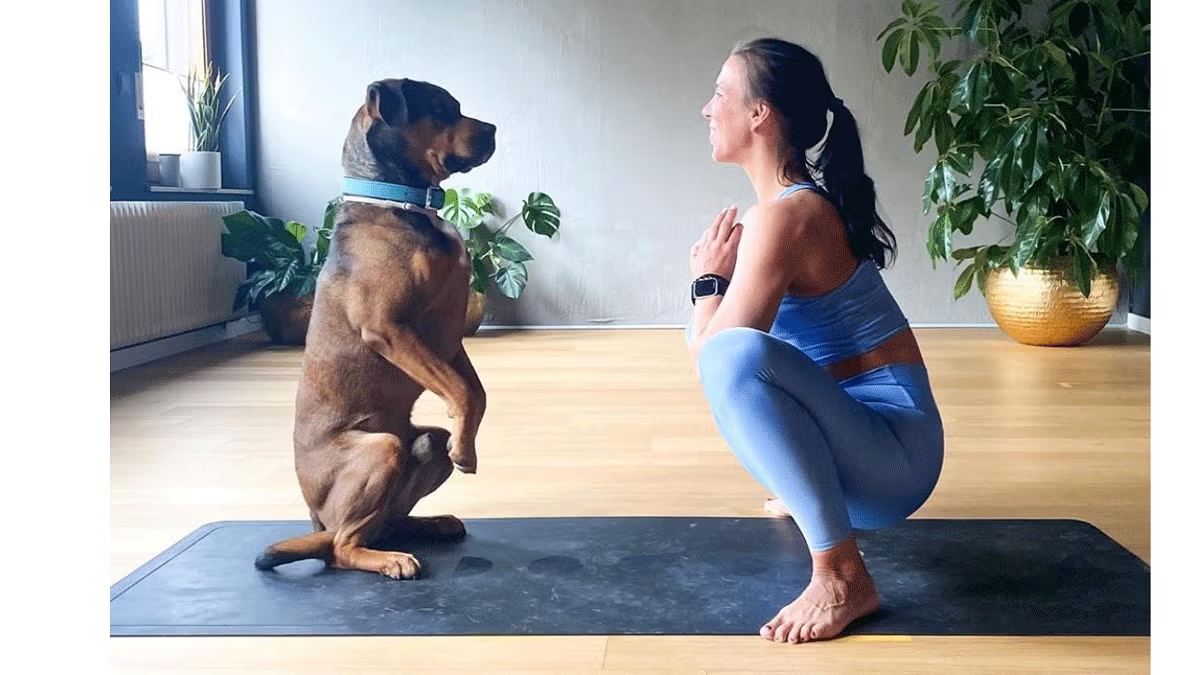
If you've been anywhere near menopause content on Instagram, you've been told to do yoga. Often by someone in expensive leggings, on a cliff, at sunrise. The implication being that your sleeplessness, irritability and 3am existential spirals will dissolve into the sea mist if you'd just commit to a daily practice.
So does yoga actually help perimenopause symptoms, or is it wellness wallpaper for women the system isn't bothered to treat properly? The trials are more interesting than the Instagram grid suggests. They are also more honest. Yoga for perimenopause symptoms isn't a miracle. But unlike most of what's being sold to women in their forties and fifties, it has been properly tested in women like you, and some of the results are encouraging. Some are not. We're going to look at both.
Why yoga keeps getting recommended for perimenopause
The pitch is straightforward. Yoga combines movement, breath work and a degree of mindfulness, all of which have been studied separately for stress, sleep and mood. Perimenopausal symptoms involve stress, sleep and mood. Therefore: yoga.
Plausible mechanisms are not the same as evidence of benefit. A lot of menopause marketing rests on plausible mechanisms and stops there. So let's look at what actually happened when researchers asked women to do yoga and measured what changed.
Does yoga help menopause symptoms? What the trials actually show
On sleep, the evidence is the strongest it's been.
A 2025 Bayesian network meta-analysis pooled non-drug interventions for menopause-related insomnia [1]. Yoga came out as one of several approaches that significantly improved sleep quality compared with doing nothing, alongside relaxation, cognitive behavioural therapy, mindfulness, aromatherapy, acupuncture, massage and general exercise. This is not yoga winning a race. It's yoga showing up in a list of things that all beat doing nothing, which is genuinely useful information if you're lying awake at 4am wondering whether any of this is worth your time.
A 2025 systematic review of exercise for menopausal sleep and psychological wellbeing reached the same conclusion [2]. Aerobic exercise, yoga, Pilates, resistance training, stretching and relaxation all improved sleep and psychological status in peri and postmenopausal women. Yoga is one effective option among several. It is not uniquely powerful.
On perimenopause symptoms more broadly, several RCTs are worth knowing about.
Susanti and colleagues randomised 208 women to a yoga intervention or control and measured symptoms and sleep quality across menopause statuses [3]. Yoga improved both. Abiç and Yilmaz Vefikuluçay ran a 10-week trial of twice-weekly yoga and saw improvements on the Menopause Rating Scale [4]. Jorge and colleagues found that Hatha yoga reduced menopause symptoms and improved quality of life in an earlier RCT [5].
A systematic review of complementary therapies for the psychological symptoms of menopause included 33 trials and concluded that yoga, alongside aromatherapy, massage and acupuncture, improved psychological symptoms [6]. The trials are heterogeneous, but the signal is consistent.
Now the awkward bit.
Elavsky and McAuley compared walking, yoga and a control group over four months [7]. Walking outperformed yoga on most of the mental health outcomes measured. This does not mean yoga is useless, but it does mean that if your only metric is "feels better mentally" and you genuinely cannot stand yoga, brisk walking may do as much or more for you. The point of evidence is to free you from the obligation to like things that don't work for you personally.
And a 2016 review concluded that across yoga, paced breathing, acupuncture, exercise, relaxation and a range of botanical supplements, the evidence was inconsistent and not high quality [8]. That review is older, and the picture has improved since, particularly for sleep. But it's a reminder that yoga has not always been the obvious answer the wellness industry now treats it as.
What Instagram tells you vs what the trials show
"Yoga fixes hot flushes." The evidence here is mixed and weaker than for sleep and mood. The 2016 review specifically flagged inconsistency [8]. If you're doing yoga for perimenopause symptoms that are mainly vasomotor, manage expectations.
"Yoga heals your nervous system." This is a sentence that means everything and nothing. The trials don't measure "nervous system healing." They measure sleep quality, depression scores, anxiety scales, menopause rating scales. Several of those improve with yoga.
"Twenty minutes a day will change your life." The trials that found benefit typically used 60-minute sessions, twice a week, for 10 to 12 weeks. That's a real commitment. Shorter, more casual practice may help, but it has not been what was tested.
"Yoga is better than HRT." No trial has shown this. Yoga is one of several non-drug options that helps some women with some symptoms, particularly sleep and mood. It is not a replacement for medical treatment of perimenopausal symptoms where that's clinically indicated.
Practical points if you're considering yoga for perimenopause
- Sleep and mood are where the evidence is strongest. If those are your priorities, this is a reasonable thing to try.
- Hot flushes are less well supported. Possible benefit, but don't bet the house on it.
- Give it 10 to 12 weeks. This is what the trials tested. If you're going to commit, commit on the timeline that has actually been studied.
- Walking works too. If yoga isn't your thing, you are not failing menopause. Walking has comparable or better evidence for mood [7].
- Talk to your GP if your symptoms are significantly affecting your life. Yoga is not a substitute for proper medical assessment, particularly for severe sleep disruption, low mood or symptoms interfering with work and relationships.
The bottom line
Yoga for perimenopause symptoms has been tested, and unlike most things marketed to us in midlife, it has reasonable evidence behind it for sleep and mood. The trials are not perfect. The effects are not dramatic. It is not better than walking, and it is not a cure for hot flushes. But if you want a non-drug option for sleep and mood that has actually been studied in women our age, this is one of the better bets on the table. Just don't expect a sunrise on a cliff.
References
- Wang Z, et al. Effectiveness of nonpharmacological interventions for menopause-related insomnia: A systematic review and Bayesian network meta-analysis. Maturitas. 2025;202:108713. PMID: 40907338. https://pubmed.ncbi.nlm.nih.gov/40907338/
- Choudhary A, Bansal K. Menopause and movement: exercise for better sleep and psychological well-being — a systematic review. Menopause. 2025;32(11):1063-1071. PMID: 40694785. https://pubmed.ncbi.nlm.nih.gov/40694785/
- Susanti HD, et al. Effects of yoga on menopausal symptoms and sleep quality across menopause statuses: A randomized controlled trial. Nurs Health Sci. 2022;24(2):368-379. PMID: 35191141. https://pubmed.ncbi.nlm.nih.gov/35191141/
- Abiç A, Yilmaz Vefikuluçay D. The Effect of Yoga on Menopause Symptoms: A Randomized Controlled Trial. Holist Nurs Pract. 2024;38(3):138-147. PMID: 38709129. https://pubmed.ncbi.nlm.nih.gov/38709129/
- Jorge MP, et al. Hatha Yoga practice decreases menopause symptoms and improves quality of life: A randomized controlled trial. Complement Ther Med. 2016;26:128-35. PMID: 27261993. https://pubmed.ncbi.nlm.nih.gov/27261993/
- Mehrnoush V, et al. Efficacy of the Complementary and Alternative Therapies for the Management of Psychological Symptoms of Menopause: A Systematic Review of Randomized Controlled Trials. J Menopausal Med. 2021;27(3):115-131. PMID: 34989185. https://pubmed.ncbi.nlm.nih.gov/34989185/
- Elavsky S, McAuley E. Physical activity and mental health outcomes during menopause: a randomized controlled trial. Ann Behav Med. 2007;33(2):132-42. PMID: 17447865. https://pubmed.ncbi.nlm.nih.gov/17447865/
- Hill DA, Crider M, Hill SR. Hormone Therapy and Other Treatments for Symptoms of Menopause. Am Fam Physician. 2016;94(11):884-889. PMID: 27929271. https://pubmed.ncbi.nlm.nih.gov/27929271/