
Testosterone is no longer a niche topic in menopause care. NHS prescriptions of testosterone gel for women in England reached 116,565 items in 2023/24 — roughly ten times higher than in 2015, when NICE guidelines first endorsed it for low sexual desire [1, 2]. Private prescriptions add significantly to this figure, and interest continues to grow, driven by patient advocacy, media attention, and the simple reality that thousands of women are reporting life-changing improvements.
And yet the scientific infrastructure has not kept pace. The research base remains thin, the equity gaps are stark, and women are still being told that symptoms beyond low libido are "not proven" — not because the evidence is negative, but because the studies largely haven't been done.
A hormone hiding in plain sight
Women produce testosterone in their ovaries and adrenal glands throughout their lives — in concentrations higher than oestrogen during the reproductive years. It plays a role in libido, arousal, bone density, muscle mass, mood, and brain function [3]. Levels decline gradually with age rather than dropping sharply at menopause as oestrogen does. And yet, despite decades of research into oestrogen replacement, the study of testosterone in women remains, as one review put it, remarkably limited given its biological significance [4].
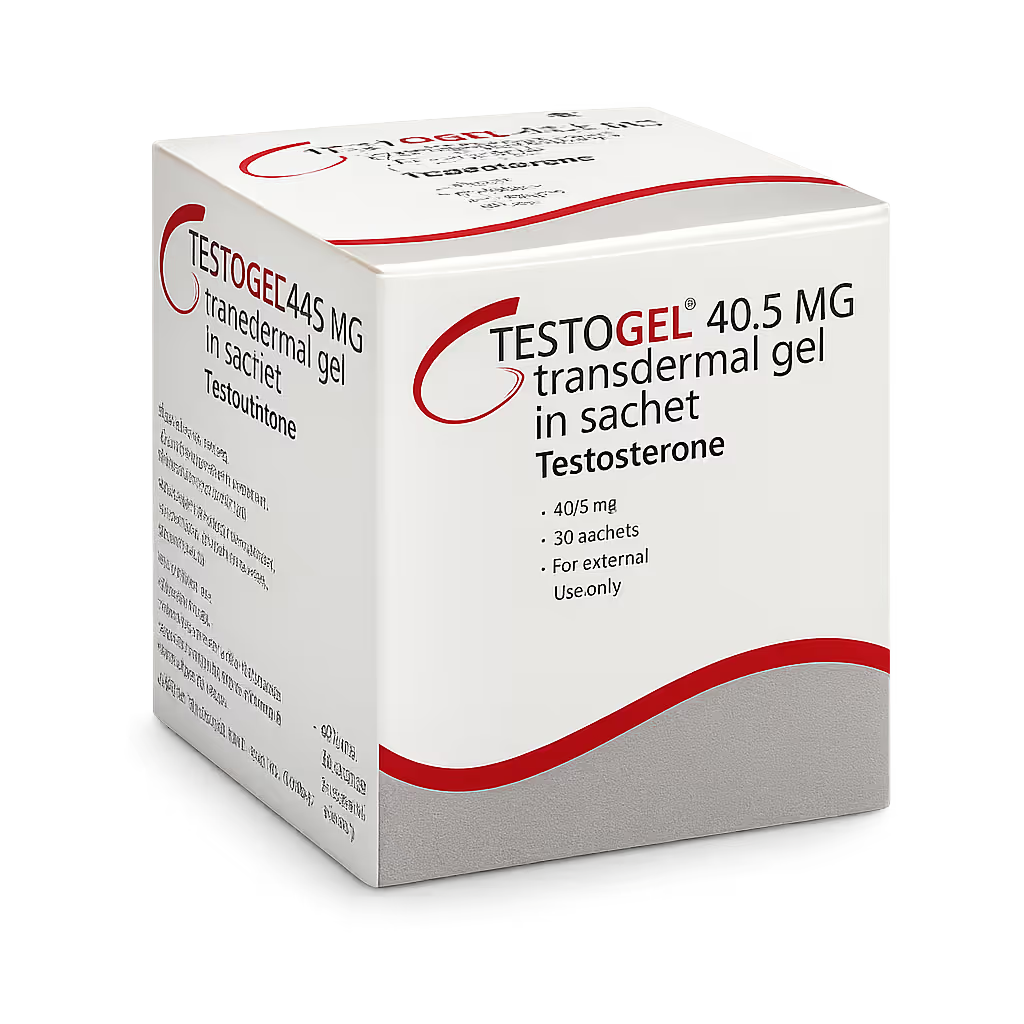
There is still no licensed testosterone product for women in the UK — something that would be unthinkable if we were talking about a hormone central to male health. Androfeme received MHRA approval in August 2025 — finally — but the UK-approved version is not expected to be available until 2026, and NHS inclusion remains unconfirmed. In the meantime, women and their clinicians make do with male-licensed products such as Testogel and Tostran, prescribed off-label at a fraction of the male dose, with all the practical awkwardness that entails [5, 6].
"The evidence for testosterone treating low sexual desire in postmenopausal women is now robust. The frustration is that this took 35 years and 36 trials to establish."
HSDD — low sexual desire that causes personal distress — affects a significant proportion of postmenopausal women. The landmark evidence is a 2019 systematic review in The Lancet pooling data from 36 randomised controlled trials involving 8,480 women [7]. Key findings:
- Transdermal testosterone significantly increased satisfying sexual encounters per month
- It improved sexual desire, arousal, and orgasm
- Benefits were seen in women on HRT and those who were not
- Side effects were mild — mainly acne and localised hair growth — and reversible with dose reduction
- No serious adverse events were identified
This underpins the Global Consensus Position Statement endorsed by ten international societies [8], and NICE's recommendation to consider testosterone for women with low desire when HRT alone is insufficient [5]. It is solid, consistent evidence. It simply took far too long to generate.
The BMS rightly notes that before testosterone is tried, other causes of low desire should be excluded — vaginal dryness (addressed with vaginal oestrogen first), relationship or psychological factors, and medication side effects such as those caused by antidepressants [6]. This is good clinical practice. But it should not become a reason to gatekeep a treatment with a strong safety profile from women who need it.
What we don't know — and urgently should
Here is where the frustration deepens. Thousands of women on testosterone report improvements that go well beyond libido — better energy, clearer thinking, improved mood, reduced anxiety, greater motivation. These are not minor quality-of-life tweaks. For many women, they describe a return to feeling like themselves. And the biological rationale is sound: testosterone receptors exist throughout the female brain, bone, and muscle.
"Women are being told these benefits are unproven — not because the evidence is negative, but because the trials haven't been done."
A 2024 pilot study of 78 peri- and postmenopausal women found significant improvements in mood (47% of women) and cognitive symptoms (39%) after four months of transdermal testosterone [9]. But it was observational, and the authors themselves acknowledged the urgent need for properly powered randomised controlled trials. The BMS's January 2026 guidance is honest about this gap: there is insufficient randomised controlled trial evidence to formally recommend testosterone for cognition, mood, energy, or musculoskeletal health [6].
That is not a verdict. It is an admission of neglect.
The ESTEEM trial — 416 women, funded by the NIHR, results expected around 2028 — is finally trying to generate that evidence, with menopause-related quality of life as its primary outcome [1]. It is welcome. It is also years overdue. That a condition affecting half the population has reached 2025 without a definitive large-scale trial on a treatment that women have been using for a decade says something deeply uncomfortable about how women's health has been prioritised in research funding.
Access is not equal — and that matters
The prescribing data make uncomfortable reading:
- NHS testosterone prescribing is three times higher in the most affluent GP practices than in the most deprived [1]
- The least deprived areas in England have more than twice as many HRT patients as the most deprived [10]
- Androfeme costs around £93–£120 per tube on private prescription — equivalent to roughly £1 a day, but inaccessible for many
- Awareness, advocacy, and access all correlate with socioeconomic status in ways that should concern anyone who cares about health equity
Women who can afford private menopause clinics and who have the confidence to advocate for themselves are getting this treatment. Women who cannot are going without — or being told their symptoms are something else entirely.
Safety: honest about what we know and don't
The short-term safety profile at female physiological doses is reassuring. The 2019 meta-analysis found no significant increase in cardiovascular events, breast cancer, or serious adverse events [7]. But the longest trials ran to only about two years, and post-market surveillance in women remains thin. This is not a reason to withhold treatment from women with clear symptoms — it is a reason to invest in the long-term data that should have been collected years ago.
Women starting testosterone should have a baseline blood test, a follow-up at three to four months, and annual monitoring to ensure levels remain within the normal premenopausal range [6]. This is straightforward, safe, and manageable in primary care.
What needs to happen
Testosterone is a legitimate, evidence-based treatment for postmenopausal women with distressing low sexual desire. The evidence on that specific point is strong. For broader symptoms — mood, cognition, energy, musculoskeletal health — the evidence is promising but incomplete, and completing it must be treated as a priority, not an afterthought.
"We should not have to fight for a treatment that is this well-evidenced. And we should not have to wait until 2028 to know whether it helps with symptoms women have been reporting for a decade."
Women deserve a research base that takes menopause seriously. That means adequately funded trials, licensed products designed for female biology, and prescribers who are trained and confident to help. The tide is turning — but not nearly fast enough.
References
[1] Shrivastava R et al. Pharmaceutical Journal. 2025. https://pharmaceutical-journal.com/article/research/testosterone-in-menopause-a-review-of-the-evidence-and-prescribing-practice
[2] Pharmaceutical Journal. NHS testosterone prescribing in women rises ten-fold in seven years. 2023. https://pharmaceutical-journal.com/article/news/nhs-testosterone-prescribing-in-women-rises-ten-fold-in-seven-years
[3] British Menopause Society. BMS Statement on Testosterone. 2024. https://thebms.org.uk/2024/07/bms-statement-on-testosterone-2/
[4] Panay N et al. Br J Gen Pract. 2020. https://pmc.ncbi.nlm.nih.gov/articles/PMC7098532/
[5] NICE. NG23. Updated 2024. https://www.nice.org.uk/guidance/ng23
[6] British Menopause Society. BMS Tool for Clinicians: Testosterone replacement in menopause. January 2026. https://thebms.org.uk/wp-content/uploads/2026/02/08-NEW-BMS-TfC-Testosterone-replacement-in-menopause-JAN2026-C.pdf
[7] Islam RM et al. Lancet Diabetes Endocrinol. 2019;7(10):754–66. https://pubmed.ncbi.nlm.nih.gov/31353194/
[8] Davis SR et al. J Sex Med. 2019;16(9):1331–7. https://pubmed.ncbi.nlm.nih.gov/31488288/
[9] Glynne S et al. Arch Womens Ment Health. 2025;28(3):541–50. https://pubmed.ncbi.nlm.nih.gov/39283522/
[10] NHS Business Services Authority. HRT England, April 2015 to June 2025. https://www.nhsbsa.nhs.uk/statistical-collections/hormone-replacement-therapy-england/hormone-replacement-therapy-england-april-2015-june-2025