
Promensil Perimenopause
Can they prove what they say?
Promensil leans on "clinically trialled ingredients" and 20+ years of research, but the product itself has never been tested, the red clover evidence is genuinely split, and the isoflavone dose here is a quarter of what studies actually used.



What is it:
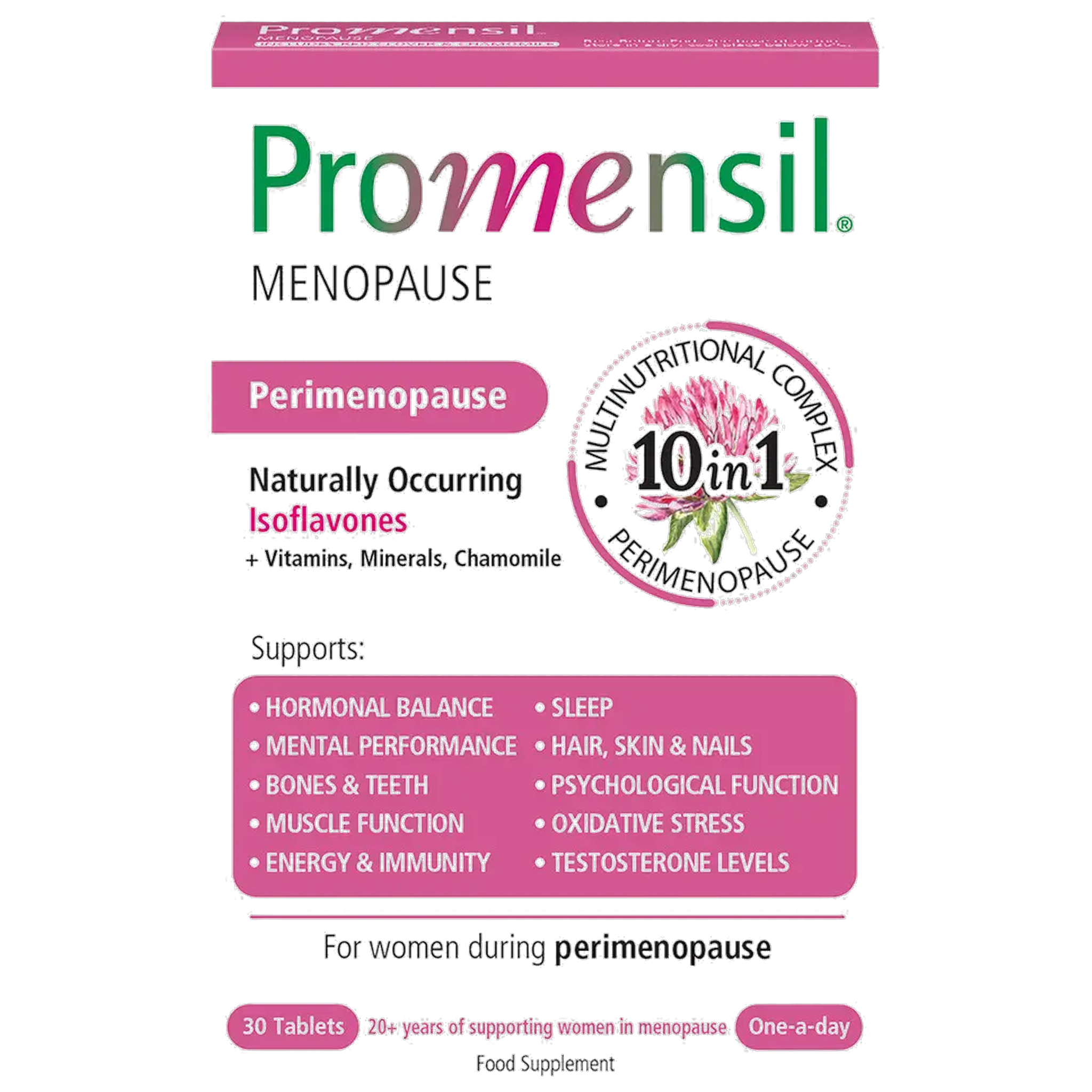
This is a daily supplement for perimenopause. It combines 20mg of red clover isoflavones (phytoestrogens), chamomile extract, and a blend of vitamins and minerals (iron, zinc, magnesium, vitamins C, D, B6, B12, biotin and pantothenic acid).
Marketing claims
- Tailored nutritional support during perimenopause for overall health and wellbeing
- Supports restful and restorative sleep (via chamomile)
- Powered by clinically trialled ingredients
- 20+ years of supporting women in menopause
- Red clover "shown in studies" to bind oestrogen receptors and reduce frequency and intensity of hot flushes
- Red clover may support bone density and heart health (cholesterol)
- Vitamin and mineral claims (B6 for hormonal activity, vitamin D and magnesium for bones, zinc for hair/skin/nails and testosterone, vitamin C for collagen and oxidative stress)
What do the guidelines say
- NICE NG23 (2015, reviewed November 2024) says there is some evidence that isoflavones may relieve vasomotor symptoms, but stresses that multiple preparations are available, their safety is uncertain, preparations vary, and interactions with other medicines have been reported. It does not recommend isoflavones as a treatment [1].
- British Menopause Society / Women's Health Concern (2025) echoes NICE and adds that isoflavones and red clover are not recommended for women who have had, or are at high risk of, breast cancer [2].
- No guideline endorses chamomile, or a vitamin-and-mineral blend, as a treatment for perimenopause symptoms.
- None of these guidelines name Promensil or this specific formula. At most they acknowledge the isoflavone category, with heavy caveats.
What does the evidence say
- For red clover isoflavones, the evidence is genuinely split. A manufacturer-linked systematic review and meta-analysis (Myers & Vigar 2017) found that standardised red clover (Promensil) at 80mg/day produced a statistically and clinically meaningful reduction in hot flushes over the short term [5]. The author affiliation and the fact that this analysis isolates the brand's own preparation should be flagged.
- The independent Cochrane review (Lethaby 2013) pooled five Promensil trials and found no significant difference in hot flush frequency versus placebo, and concluded there is no conclusive evidence that phytoestrogen supplements work [3][4]. A broader phytoestrogen meta-analysis (Chen 2014) found only a modest reduction in hot flush frequency and no effect on overall symptom scores [8].
- Crucially, the supportive evidence used 80mg of isoflavones. This product contains 20mg per tablet — a quarter of that dose — and has not been tested at this level. The product itself has zero published trials and, at time of writing, zero reviews on its own site.
- For chamomile, two small recent triple-blind RCTs in postmenopausal women (Mohsenzadeh-Ledari 2025, 2026) reported reduced vasomotor and some symptom scores, but at 400mg+ standardised to apigenin [6][7]. Both reported mild side effects (mouth sores, skin reactions) causing dropouts. These are single-team, small, non-UK studies — early signal, not established evidence — and the dose and form differ from what's in this product.
- For the vitamins and minerals, the on-pack benefits (vitamin B6 for hormonal activity, vitamin D for bones, zinc for hair/skin/nails) are EU-authorised general nutritional function claims. They are not evidence that the product relieves perimenopause symptoms, and apply to anyone, not just menopausal women.
Claims that go beyond the evidence
- "Powered by clinically trialled ingredients" is technically defensible for the ingredients in isolation, but it implies a level of product-specific evidence that does not exist. The product has never been trialled, and the isoflavone dose is far below the trialled amount.
- "Shown in studies" to reduce hot flush frequency and intensity overstates the evidence base. The strongest positive result is manufacturer-linked and used four times this dose.
- "Supports restful and restorative sleep" rests on chamomile, where menopause-specific sleep evidence is thin and comes from small trials at a different dose.
- Bone and heart claims for red clover are described as needing "more research," which is honest, but they still sit on the page as benefits.
Bottom line
If you have mild perimenopause symptoms and no history of breast cancer, this is a low-risk supplement and it's unlikely to harm you. But the honest position is that the evidence behind it is weak and pulls in opposite directions. The studies that look promising for red clover used four times the isoflavone dose this product actually contains, and the product itself has never been tested. The vitamin and mineral claims are real but generic — they're about basic nutrition, not menopause. Read "clinically trialled ingredients" as marketing, not proof. If your symptoms are affecting your daily life, the treatments with by far the strongest evidence are prescription options, including HRT, which are worth discussing with your GP.
References
- NICE. Menopause: identification and management. NICE Guideline NG23. 2015 (reviewed November 2024). Available at: https://www.nice.org.uk/guidance/ng23. No PMID (clinical guideline).
- Women's Health Concern / British Menopause Society. Complementary and Alternative Therapies (factsheet). 2025. Available at: https://www.womens-health-concern.org/wp-content/uploads/2025/11/03-NEW-WHC-FACTSHEET-Complementary-And-Alternative-Therapies-NOV2025-B.pdf. No PMID (clinical guideline).
- Lethaby A, Marjoribanks J, Kronenberg F, et al. Phytoestrogens for menopausal vasomotor symptoms. Cochrane Database Syst Rev 2013;2013(12):CD001395. PMID: 24323914. https://pubmed.ncbi.nlm.nih.gov/24323914/
- Lethaby AE, Brown J, Marjoribanks J, et al. Phytoestrogens for vasomotor menopausal symptoms. Cochrane Database Syst Rev 2007;(4):CD001395. PMID: 17943751. https://pubmed.ncbi.nlm.nih.gov/17943751/
- Myers SP, Vigar V. Effects of a standardised extract of Trifolium pratense (Promensil) at a dosage of 80mg in the treatment of menopausal hot flushes: a systematic review and meta-analysis. Phytomedicine 2017;24:141-147. PMID: 28160855. https://pubmed.ncbi.nlm.nih.gov/28160855/
- Mohsenzadeh-Ledari F, Agajani Delavar M, Moghadamnia AA, et al. Efficacy and safety of Matricaria chamomilla intervention in managing menopausal symptoms: a triple-blind clinical trial. Menopause 2025;32(4):353-358. PMID: 39836709. https://pubmed.ncbi.nlm.nih.gov/39836709/
- Mohsenzadeh-Ledari F, Delavar MA, Moghadamnia AA, et al. Effect of chamomile on the quality of life among women with menopausal symptoms: a triple-blind randomized controlled trial. J Integr Complement Med 2026. PMID: 41761999. https://pubmed.ncbi.nlm.nih.gov/41761999/
- Chen MN, Lin CC, Liu CF. Efficacy of phytoestrogens for menopausal symptoms: a meta-analysis and systematic review. Climacteric 2014;18(2):260-269. PMID: 25263312. https://pubmed.ncbi.nlm.nih.gov/25263312/
Biotin
Chamomile
Magnesium
Vitamin C
Red Clover
Zinc
Vitamin B12
Pantothenic acid
Vitamin D
Vitamin B6

Related Articles
You might be intrested in reading...