
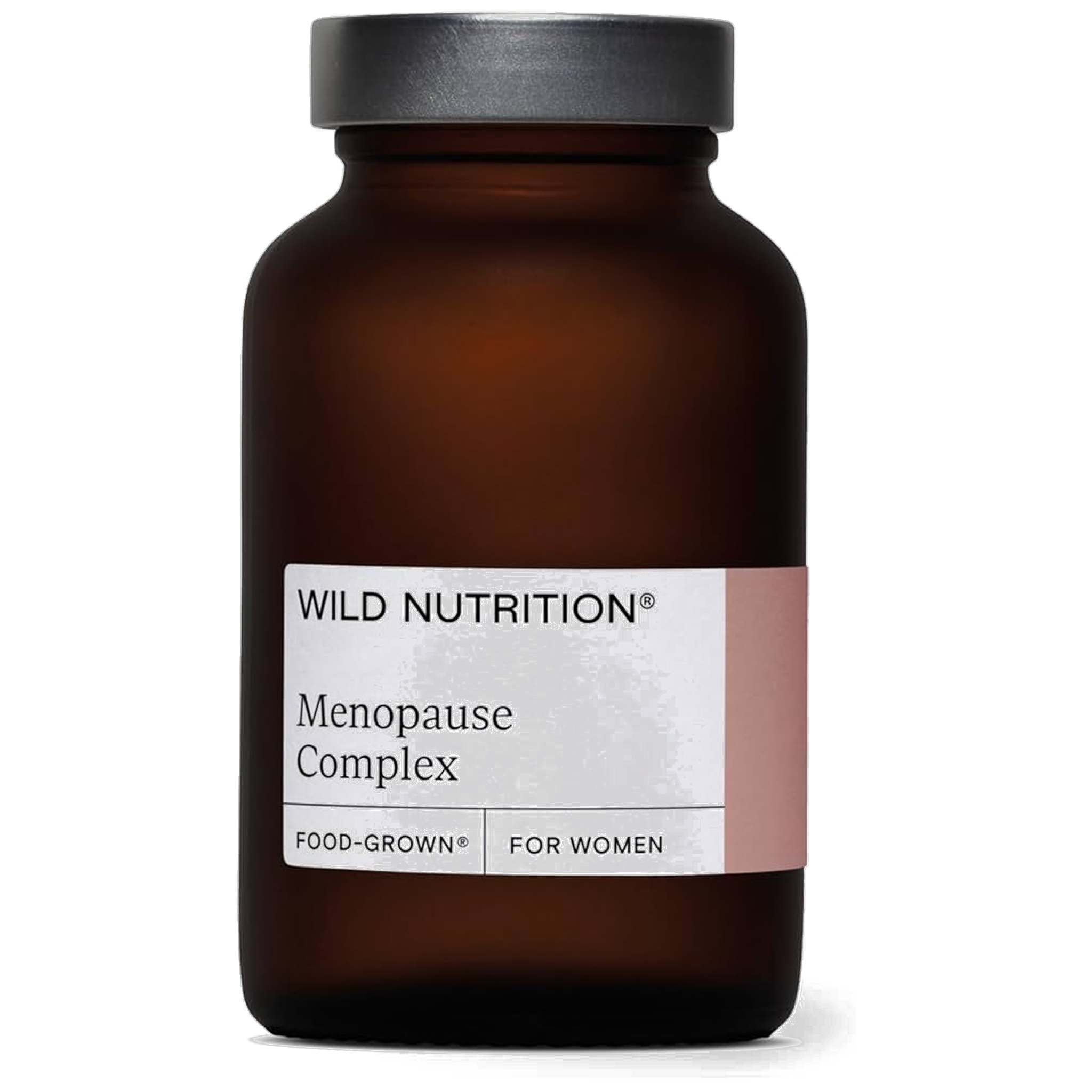
Wild Nutrition Perimenopause Complex
Can they prove what they say?
Partly. The two botanicals doing the marketing work, Shatavari and Safr'Inside saffron, do have some trial evidence for mood in menopause. But the trials used different, standardised extracts, not the forms in this capsule, and the product itself has never been tested. The vitamins and minerals carry only general "normal function" claims, not perimenopause-symptom claims.

What it is:
A daily two-capsule supplement combining two botanicals (Shatavari and Safr'Inside saffron extract) with vitamins and minerals (B6, pantothenic acid, magnesium, iron, molybdenum) plus N-Acetyl L-Cysteine, marketed specifically for the perimenopause life stage.
What does the trial evidence show?
No RCT or systematic review has tested Wild Nutrition Perimenopause Complex as a whole product. For individual ingredients:
- Saffron (30mg as Safr'Inside): A 2021 RCT in perimenopausal women found a saffron extract improved mood and psychological symptoms versus placebo, but not hot flushes [4]. Catch: that trial used a different branded extract (affron), not Safr'Inside. Different extracts can't be assumed to behave the same way, so it doesn't directly prove this product's saffron.
- Shatavari (500mg powder): Two RCTs in menopausal women reported improvements in menopause symptom and mood scores [5][6]. Both used standardised, concentrated root extracts. This product uses raw Shatavari powder, which is not the same as the tested extracts, so the results don't transfer cleanly.
- N-Acetyl L-Cysteine and molybdenum: No RCT or systematic review evidence was found for either in perimenopause symptom relief.
- Vitamins and minerals (B6, magnesium, iron, pantothenic acid): Claims rest on well-established physiological functions (e.g. B6 and "normal hormonal activity," magnesium and "normal psychological function"), not menopause-specific trials. These are permitted general nutrient claims.
What do guidelines say?
NICE guideline NG23 does not recommend supplements like this for perimenopause. It notes only that there is "some evidence" isoflavones or black cohosh (different ingredients, not in this product) may relieve hot flushes, while cautioning that preparations vary and safety is uncertain [1].
The BMS non-hormonal consensus statement (2024) centres its advice on treatments with stronger evidence and does not name or endorse this product [2]. EMAS states there is insufficient or conflicting evidence that supplements relieve vasomotor symptoms [3]. The 2025 International Menopause Society systematic review of 158 studies found most evidence for herbs and nutrients was low or very low certainty [7]. None of these bodies name Shatavari, Safr'Inside, or this product.
Bottom Line
The two star ingredients aren't snake oil. There's early, genuine trial evidence that saffron and Shatavari can lift mood in perimenopause, and if low mood is your main issue and you want a hormone-free option, this is a reasonable thing to try. But go in with clear eyes: the saffron trial used a different branded extract (affron, not Safr'Inside), the Shatavari trials used concentrated root extracts rather than the raw powder in this jar, and nobody has ever tested this actual product. The "hormone regulation" and energy messaging leans on basic nutrient-function claims, not perimenopause studies. If you're chasing hot flush relief, the evidence here is at its weakest.
References
[1] National Institute for Health and Care Excellence. Menopause: Identification and Management (NG23). Published November 2015, updated November 2024. Available at: https://www.nice.org.uk/guidance/ng23. No PMID (clinical guideline).
[2] British Menopause Society. BMS Consensus Statement: Non-hormonal-based treatments for menopausal symptoms. 2024. Available at: https://thebms.org.uk/wp-content/uploads/2024/09/04-BMS-ConsensusStatement-Non-hormonal-based-treatments-SEPT2024-A.pdf. No PMID (clinical guideline).
[3] Mintziori G, Lambrinoudaki I, Goulis DG et al. EMAS position statement: Non-hormonal management of menopausal vasomotor symptoms. Maturitas 2015;81(3):410-413. PMID: 26044075. https://pubmed.ncbi.nlm.nih.gov/26044075/
[4] Lopresti AL, Smith SJ. The effects of a saffron extract (affron) on menopausal symptoms in women during perimenopause: a randomised, double-blind, placebo-controlled study. J Menopausal Med 2021;27(2):66-78. PMID: 34463069. https://pubmed.ncbi.nlm.nih.gov/34463069/
[5] Gudise VS, Dasari MP, Kuricheti SSK. Efficacy and safety of Shatavari root extract for the management of menopausal symptoms: a double-blind, multicenter, randomized controlled trial. Cureus 2024;16(4):e57879. PMID: 38725756. https://pubmed.ncbi.nlm.nih.gov/38725756/
[6] Ademola J, Ajgaonkar A, Debnath T et al. Efficacy and safety of Shatavari root extract (Asparagus racemosus) for menopausal symptoms: a randomized, double-blind, three-arm, placebo-controlled study. Front Reprod Health 2025;7:1654503. PMID: 41394012. https://pubmed.ncbi.nlm.nih.gov/41394012/
[7] International Menopause Society. Complementary therapies for management of menopausal symptoms: a systematic review to inform the update of the IMS recommendations on women's midlife health. Climacteric 2025. Available at: https://www.tandfonline.com/doi/full/10.1080/13697137.2025.2584061. No PMID (systematic review informing guideline).
Vitamin B6
Pantothenic acid
Magnesium
Iron
N-Acetyl L-Cysteine
Shatavari powder
Saffron

Related Articles
You might be intrested in reading...