
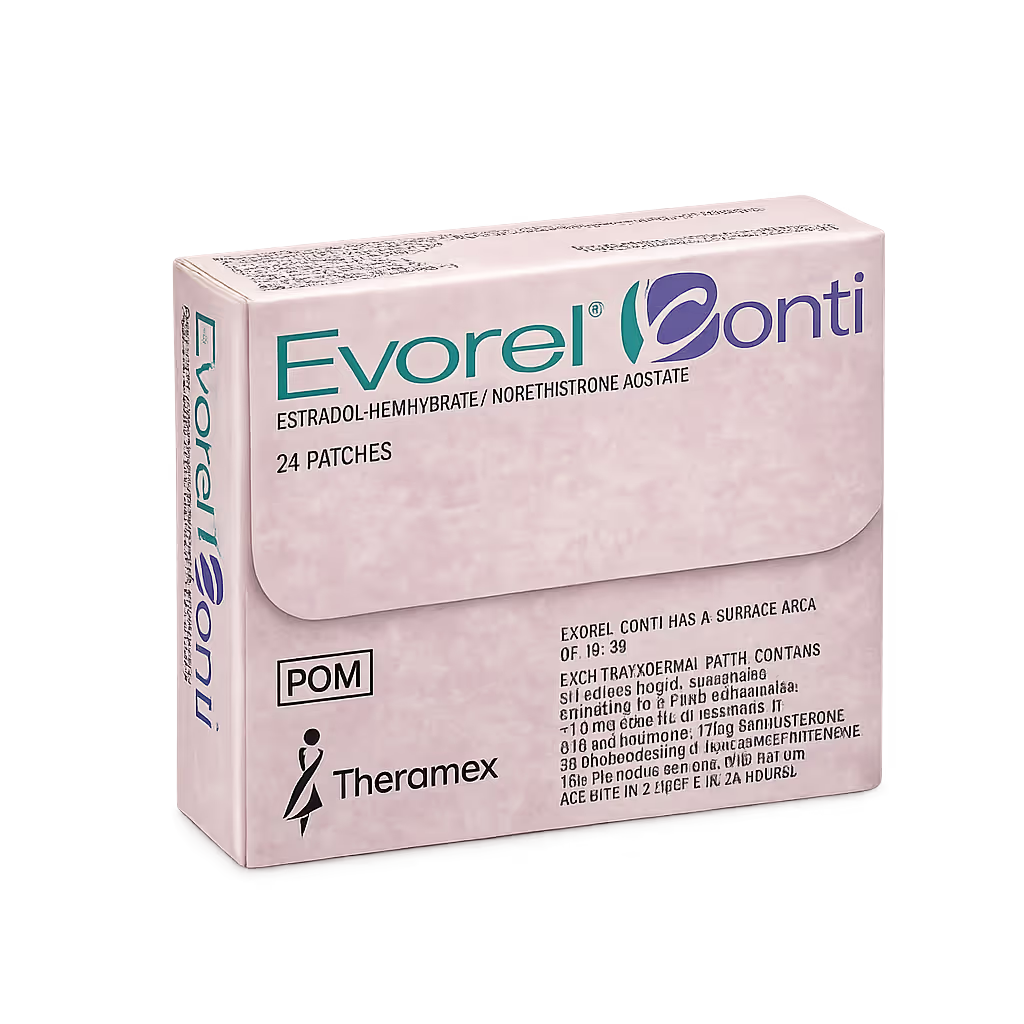
Evorel Conti
Can they prove what they say?
Yes. Evorel Conti is a combination patch covering oestradiol and a synthetic progestin. It is proven to relieve oestrogen deficiency symptoms and protect the uterus. But as a synthetic progestin, there's a growing body of evidence that breast cancer risk is higher vs micronised progesterone so it scores lower.



What it is:
Evorel Conti is a continuous combined HRT patch containing two hormones in one: 50 micrograms of oestradiol and 170 micrograms of norethisterone acetate per 24 hours. [1] It is applied twice a week and is designed for postmenopausal women who have not had a period for at least 12 to 18 months. Because both hormones are delivered continuously, most women using it do not have a monthly bleed, which is one of its main practical advantages over sequential HRT.
What do the guidelines say?
- NICE NG23 (updated 2024) [1] recommends combined HRT (oestrogen plus progestogen) for women who have a womb. It notes that transdermal oestrogen does not increase the risk of VTE and is preferred for women with risk factors. NICE does not name Evorel Conti specifically. It recommends the category of combined HRT.
- BMS/WHC Consensus Statement (2020, updated 2025) [2] states that transdermal oestradiol should be considered as the "first choice route" for women with VTE risk factors. It notes that transdermal delivery is unlikely to increase the risk of blood clots or stroke compared to non-users. However, the BMS also notes that micronised progesterone and dydrogesterone carry a lower breast cancer risk than synthetic progestogens like norethisterone. This is relevant because Evorel Conti contains norethisterone, a synthetic progestogen.
- NAMS Position Statement (2022) [3] states that HRT is the most effective treatment for vasomotor symptoms. It notes that transdermal routes "may decrease risk of venous thromboembolism and stroke." The benefits outweigh the risks for most healthy symptomatic women under 60 or within 10 years of menopause.
- IMS/EMAS and other international bodies reach similar conclusions: HRT is first-line for moderate to severe vasomotor symptoms, and transdermal delivery has advantages for VTE risk [3].
What does the evidence say?
- Evorel Conti itself was tested in three clinical trials of up to one year, involving 196 women [4]. These showed relief of menopausal symptoms within the first few weeks. 92% of women with well-established menopause were bleed-free by months 10-12. Bone mineral density at the lumbar spine increased by about 3% after one year, and 90% of women maintained or gained bone density. These are relatively small trials by modern standards.
- Combined HRT broadly has a very large evidence base. A Cochrane review of 22 RCTs (over 43,000 women) confirmed that HRT is effective for symptom relief but also quantified risks including a small increase in VTE, stroke, and breast cancer with combined therapy containing a synthetic progestin or synthetic oestrogen[5].
- Transdermal oestradiol for hot flushes has been confirmed effective in a systematic review of 9 RCTs, which found it significantly reduced the number of daily hot flushes compared with placebo at all dose levels tested [7].
- Sleep: HRT improves sleep, but only when poor sleep is caused by night sweats/hot flushes. Two meta-analyses [9] [10]) confirm this. Without vasomotor symptoms, no benefit vs placebo. Objective sleep measures (polysomnography) showed no improvement. No trial has tested Evorel Conti specifically for sleep. Notably, insomnia is listed as a common side effect of the product itself.
- Mood: Oestrogen can improve menopausal low mood, but the effect is stronger in perimenopause than postmenopause, and stronger with oestrogen alone than combined HRT [11][12]. Evorel Conti is licensed only for postmenopausal women and contains norethisterone, which may blunt mood benefits compared to oestrogen alone or oestrogen with micronised progesterone. NICE says consider HRT for depressive symptoms linked to menopause, but not as a treatment for clinical depression [1]. No trial has tested Evorel Conti specifically for mood.
- GSM (vaginal dryness, painful sex, urinary symptoms): This is the weakest claim. The label lists these symptoms, and systemic oestrogen does have some effect on vaginal tissues. But every major guideline [1], [3], [15]) recommends local vaginal oestrogen as the treatment for GSM, not systemic HRT. A 2024 systematic review of 46 RCTs confirmed vaginal oestrogen works for GSM; systemic HRT has limited efficacy for these symptoms specifically [13]. Many women on Evorel Conti will still need vaginal oestrogen on top. This is the biggest gap between what the marketing implies and what guidelines recommend.
- The transdermal route and blood clot risk: A systematic review and meta-analysis of 15 observational studies found that oral oestrogen was associated with a higher VTE risk compared to transdermal (RR 1.63) [8]. However, this meta-analysis included only observational studies, not RCTs, and the authors classified this as "low confidence" evidence. No large RCT has directly compared oral vs transdermal HRT for VTE outcomes.
- Norethisterone acetate and breast cancer risk: The BMS notes that evidence from large observational studies suggests micronised progesterone and dydrogesterone carry a lower breast cancer risk than norethisterone and other synthetic progestogens [2]. The Evorel Conti label includes breast cancer risk data, noting an increased risk with combined HRT that depends on duration of use [4].
References
[1] NICE. Menopause: identification and management (NG23). 2015 (updated November 2024). Available at: https://www.nice.org.uk/guidance/ng23. No PMID (clinical guideline).
[2] British Menopause Society / Women's Health Concern. BMS/WHC 2020 Recommendations on hormone replacement therapy in menopausal women (updated 2025). Available at: https://thebms.org.uk/publications/consensus-statements/bms-whcs-2020-recommendations-on-hormone-replacement-therapy-in-menopausal-women/. No PMID (consensus statement).
[3] Faubion S et al. The 2022 hormone therapy position statement of The North American Menopause Society. Menopause 2022;29(7):767-794. PMID: 35797481. https://pubmed.ncbi.nlm.nih.gov/35797481/
[4] Theramex. Evorel Conti Summary of Product Characteristics (SmPC). Last updated May 2025. Available at: https://www.medicines.org.uk/emc/product/10929/smpc. No PMID (regulatory document).
[5] Marjoribanks J et al. Long-term hormone therapy for perimenopausal and postmenopausal women. Cochrane Database Syst Rev 2017;1:CD004143. PMID: 28093732. https://pubmed.ncbi.nlm.nih.gov/28093732/
[6] Kim JE et al. Menopausal hormone therapy and women's health: An umbrella review. PLoS Med 2021;18(8):e1003731. Available at: https://journals.plos.org/plosmedicine/article?id=10.1371/journal.pmed.1003731. No single PMID (umbrella review).
[7] Corbelli J et al. Low-dose transdermal estradiol for vasomotor symptoms: a systematic review. Menopause 2015;22(1):114-121. PMID: 24977458. https://pubmed.ncbi.nlm.nih.gov/24977458/
[8] Mohammed K et al. Oral vs transdermal estrogen therapy and vascular events: a systematic review and meta-analysis. J Clin Endocrinol Metab 2015;100(11):4012-4020. PMID: 26544651. https://pubmed.ncbi.nlm.nih.gov/26544651/
[9] Cintron D et al. Efficacy of menopausal hormone therapy on sleep quality: systematic review and meta-analysis. Endocrine 2017;55:702-711. PMID: 27515805. https://pubmed.ncbi.nlm.nih.gov/27515805/
[10] Pan Z et al. Different regimens of menopausal hormone therapy for improving sleep quality: a systematic review and meta-analysis. Menopause 2022;29(5):627-635. PMID: 35102100. https://pubmed.ncbi.nlm.nih.gov/35102100/
[11] Zweifel JE, O'Brien WH. A meta-analysis of the effect of hormone replacement therapy upon depressed mood. Psychoneuroendocrinology 1997;22(3):189-212. PMID: 9203229. https://pubmed.ncbi.nlm.nih.gov/9203229/
[12] Hu J et al. Pharmacological interventions and hormonal therapies for depressive symptoms in peri- and post-menopausal women: a network meta-analysis of randomized controlled trials. Psychiatry Research 2023;325:115250. Available at: https://www.sciencedirect.com/science/article/abs/pii/S0165178123002664
[13] Danan ER et al. Hormonal treatments and vaginal moisturizers for genitourinary syndrome of menopause: a systematic review. Ann Intern Med 2024;177(10):1400-1414. PMID: 39250810. https://pubmed.ncbi.nlm.nih.gov/39250810/
[14] Tunitsky-Bitton E. Update in female hormonal therapy: what the urologist should know. Rev Urol 2020;22(4):160-168. PMC8058921. https://pmc.ncbi.nlm.nih.gov/articles/PMC8058921/
[15] AUA/SUFU/AUGS. Genitourinary Syndrome of Menopause Guideline. 2025. Available at: https://www.auanet.org/guidelines-and-quality/guidelines/genitourinary-syndrome-of-menopause. No PMID (clinical guideline).
Norethisterone acetate
Oestradiol

Related Articles
You might be intrested in reading...