
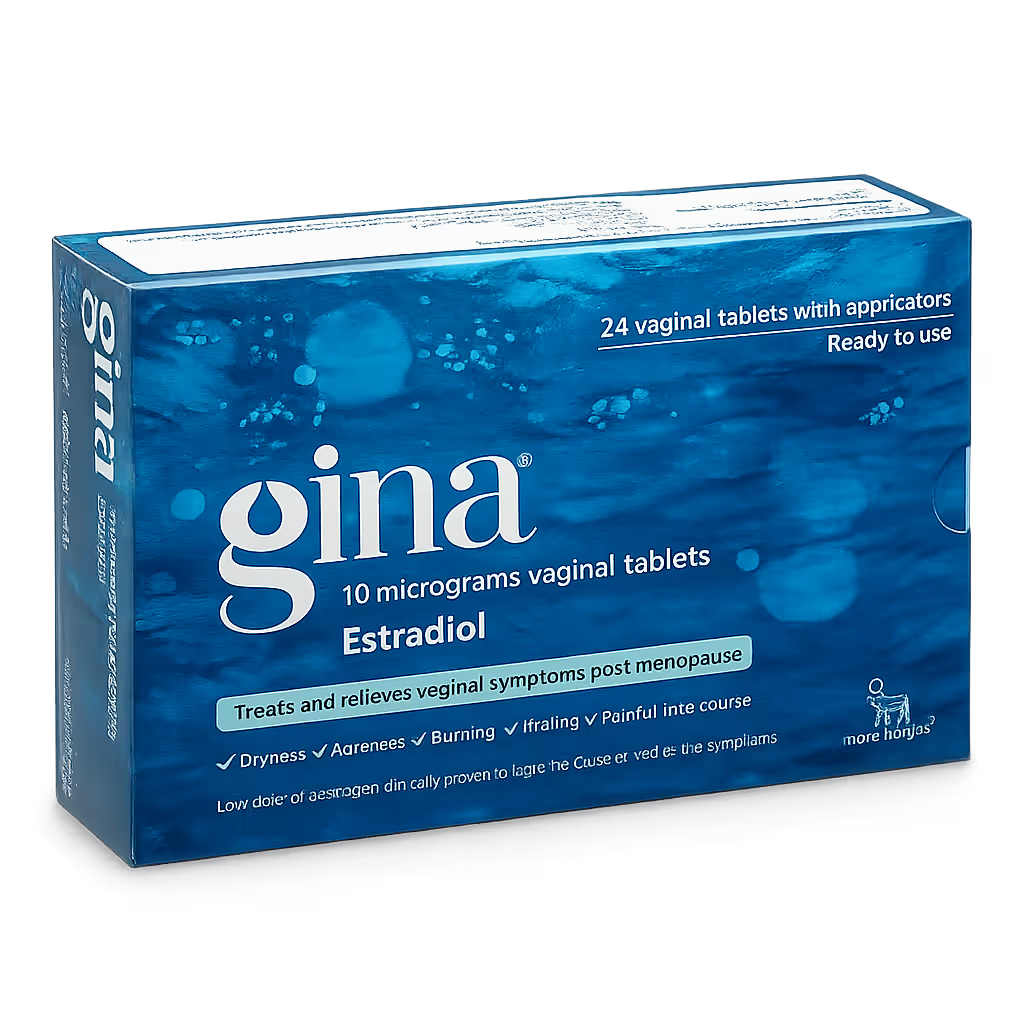
Gina (also sold as Vagifem)
Can they prove what they say?
Yes. Lots of high-quality studies show vaginal oestrogen tablets treat the hormonal root cause of vaginal dryness, not just the surface symptoms. This is why it's endorsed across major UK and international guidelines.


What it is:
Gina is a low-dose oestrogen tablet (10mcg oestradiol) inserted into the vagina. It's used for vaginal dryness, soreness, itching and painful sex caused by the menopause [5].
What does the clinical trial evidence show?
A large, well-designed RCT [5] showed that women using the tablet had measurably healthier vaginal tissue within 2 weeks and statistically significant symptom improvement by week 8, with effects lasting a full year. No significant safety problems were found.
The Cochrane review [6], covering 30 trials and 6,235 women, confirms that vaginal oestrogen tablets work, but rates the overall evidence base as "low to moderate quality" because of inconsistent reporting across trials. Importantly, all formulations (tablets, creams, rings) appear similarly effective; there's no strong evidence one is better than another.
One 2024 meta-analysis [7] also showed measurable improvements in vaginal cell health and pain during sex, but found that vaginal dryness as a standalone outcome was not statistically significant.
What do the guidelines say?
- NICE NG23 (updated November 2024) [1]: Recommends offering vaginal oestrogen (as a cream, tablet, gel, pessary or ring) to any woman with symptoms of vaginal dryness/atrophy. It can be used even if you're already on systemic HRT. Symptoms often return if treatment stops, but it can be restarted. Vaginal oestrogen can also be considered for women with a history of breast cancer whose symptoms persist despite non-hormonal options.
- British Menopause Society Consensus Statement (2025) [2] and BSSM Position Statement (2024) [3]: Both endorse vaginal oestrogen as first-line treatment, calling current treatments "effective, safe and cost-effective."
- NAMS 2020 Position Statement [4]: Recommends low-dose vaginal oestrogens as effective for moderate to severe GSM. Progestogen does not need to be added for endometrial protection at this dose.
References
[1] NICE. Menopause: identification and management. NICE guideline NG23. 2015, updated November 2024. Available at: https://www.nice.org.uk/guidance/ng23. No PMID (clinical guideline).
[2] British Menopause Society. BMS Consensus Statement on Genitourinary Syndrome of Menopause (GSM). November 2025. Available at: https://thebms.org.uk/publications/consensus-statements/genitourinary-syndrome-of-menopause-gsm/. No PMID (clinical guideline).
[3] British Society for Sexual Medicine. Position Statement for Management of Genitourinary Syndrome of the Menopause (GSM). January 2024 (revised). Available at: https://bssm.org.uk/wp-content/uploads/2024/03/BSSM-Position-statement-for-management-of-genitourinary-syndrome-of-the-menopause-GSM.pdf. No PMID (clinical guideline).
[4] The North American Menopause Society. The 2020 genitourinary syndrome of menopause position statement of The North American Menopause Society. Menopause 2020;27(9):976–992. PMID: 32852449. https://pubmed.ncbi.nlm.nih.gov/32852449/
[5] Simon J et al. Effective treatment of vaginal atrophy with an ultra-low-dose estradiol vaginal tablet. Obstet Gynecol 2008;112(5):1053–60. PMID: 18978105. https://pubmed.ncbi.nlm.nih.gov/18978105/
[6] Lethaby A, Ayeleke RO, Roberts H. Local oestrogen for vaginal atrophy in postmenopausal women. Cochrane Database Syst Rev 2016;8:CD001500. PMID: 27577677. https://pubmed.ncbi.nlm.nih.gov/27577677/
[7] Ali A et al. Efficacy and Safety of Intravaginal Estrogen in the Treatment of Atrophic Vaginitis: A Systematic Review and Meta-Analysis. J Menopausal Med 2024;30(2):88–103. PMID: 39315501. https://pubmed.ncbi.nlm.nih.gov/39315501/
[8] Comini ACM et al. Safety and Serum Estradiol Levels in Hormonal Treatments for Vulvovaginal Atrophy in Breast Cancer Survivors: A Systematic Review and Meta-Analysis. Clin Breast Cancer 2023;23(8):835–846. PMID: 37806915. https://pubmed.ncbi.nlm.nih.gov/37806915/
[9] Pavlović RT et al. The Safety of Local Hormonal Treatment for Vulvovaginal Atrophy in Women With Estrogen Receptor-positive Breast Cancer Who Are on Adjuvant Aromatase Inhibitor Therapy: Meta-analysis. Clin Breast Cancer 2019;19(6):e731–e740. PMID: 31522958. https://pubmed.ncbi.nlm.nih.gov/31522958/
Oestradiol

Related Articles
You might be intrested in reading...