
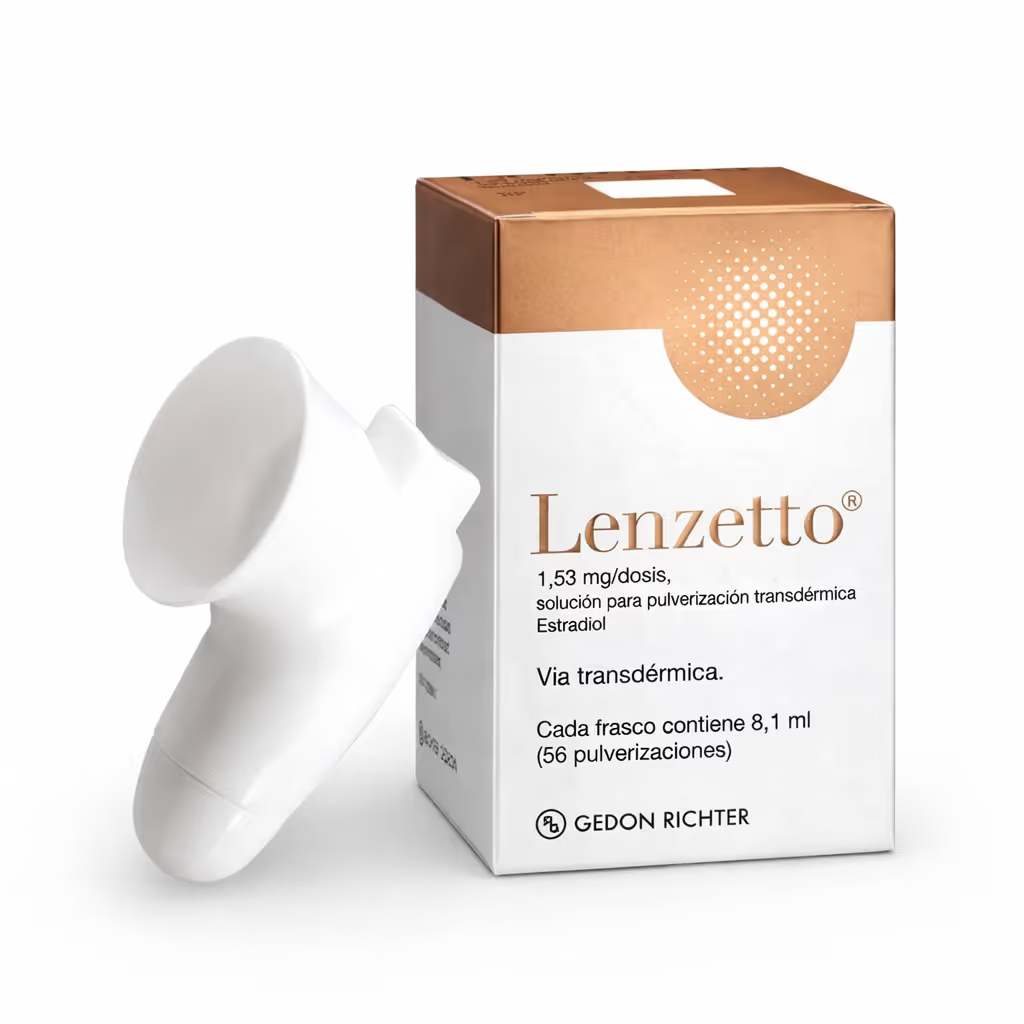
Lenzetto
Can they prove what they say?
Yes. Lenzetto is an oestradiol spray proven to relieve oestrogen deficiency symptoms. The high-quality, high-volume of evidence, plus its safety profile make it a first-line HRT choice in current UK/international guidelines.




What it is:
Lenzetto is a transdermal oestradiol spray used as part of hormone replacement therapy (HRT) for menopausal symptoms including hot flushes and night sweats.
What do the guidelines say?
NICE guideline NG23 [1] recommends that HRT should be offered to women with vasomotor symptoms, with transdermal oestradiol listed as an accepted delivery route (patch, gel, or spray). NICE specifically recommends considering transdermal rather than oral HRT for women at increased risk of venous thromboembolism (VTE), including those with a BMI above 30.
The BMS/WHC 2020 Recommendations on HRT [2] similarly state that transdermal oestradiol is unlikely to increase VTE or stroke risk above baseline and should be considered the first-choice route for women with risk factors. They also recommend individualised dosing and no arbitrary limits on duration.
NICE NG23 [1] and the BMS 2020 guidelines [2] both acknowledge bone protection as a benefit
Neither guideline names Lenzetto by brand, but both recognise transdermal oestradiol spray as a legitimate and recommended formulation class.
What does the trial evidence show?
The Lenzetto formulation itself was tested in one double-blind, placebo-controlled Phase III RCT [3], conducted in 454 postmenopausal women across multiple centres. Participants had at least eight moderate-to-severe hot flushes per day. Women were randomised to one, two, or three sprays daily or placebo. All three active dose groups showed statistically significant reductions in hot flush frequency and severity at weeks 4 and 12 (p<0.01). At week 12, 74 to 85% of women on active treatment achieved a 50% or greater reduction in hot flush frequency, compared with 46% in the placebo group. Application site reactions were low and comparable to placebo (1.3% vs 1.8%).
A meta-analysis by Kovacs et al (2016) [4] compared the oestradiol spray indirectly with oestradiol patches across eight RCTs. It found no significant difference in efficacy between the spray and patches at similar doses, and the spray performed better for local skin reactions.
What does the broader evidence say for transdermal oestradiol?
A systematic review by Corbelli et al (2015) [5] examined nine RCTs of low-dose transdermal oestradiol and found consistent evidence that all dose ranges were more effective than placebo for reducing hot flush frequency, with a generally low risk of bias across studies.
A network meta-analysis by Sarri et al (2017) [6], conducted for the NICE guideline development group, analysed 47 RCTs across 8,326 women and found that transdermal oestradiol combined with a progestogen had the highest probability of being the most effective treatment for vasomotor symptom relief compared with all other interventions.
On the question of blood clot risk, a meta-analysis by Scarabin (2018) [8] updated previous analyses and confirmed that oral oestrogen was associated with a 48% increased VTE risk (RR 1.48), whereas transdermal oestradiol did not increase VTE risk compared with non-users (RR 0.97). When combined with micronised progesterone, the transdermal route still showed no significant increase in VTE risk
References
[1] NICE. Menopause: identification and management. NG23. 2015, updated November 2024. Available at: https://www.nice.org.uk/guidance/ng23. No PMID (clinical guideline).
[2] British Menopause Society and Women's Health Concern. BMS and WHC's 2020 recommendations on hormone replacement therapy in menopausal women. 2020. Available at: https://thebms.org.uk/publications/consensus-statements/bms-whcs-2020-recommendations-on-hormone-replacement-therapy-in-menopausal-women/. No PMID (clinical guideline).
[3] Buster J E et al. Obstet Gynecol 2008;111:1343-51. PMID: 18515518. https://doi.org/10.1097/AOG.0b013e318175d162
[4] Kovacs G et al. Climacteric 2016;19:488-95. PMID: 27593417. https://doi.org/10.1080/13697137.2016.1221919
[5] Corbelli J et al. Menopause 2015;22:114-21. PMID: 24977458. https://doi.org/10.1097/GME.0000000000000258
[6] Sarri G et al. BJOG 2017;124:1514-1523. PMID: 28276200. https://doi.org/10.1111/1471-0528.14619
[7] Lenzetto (oestradiol) 1.53 mg/spray. Summary of Product Characteristics. Gedeon Richter. Accessed January 2026. Available at: https://www.medicines.org.uk/emc/product/11175/smpc. No PMID (regulatory document).
[8] Scarabin P-Y. Climacteric 2018;21:341-345. PMID: 29570359. https://doi.org/10.1080/13697137.2018.1446931
[9] Baber R J et al (IMS Writing Group). Climacteric 2016;19:109-150. Available at: https://www.imsociety.org. No PMID (international guideline).
Oestradiol

Related Articles
You might be intrested in reading...